In our last episode of The Adventures of an 11mm Brain Aneurysm, our pesky friend was allowing what appeared to be more blood into the neck of the aneurysm. After 16 platinum coils were inserted in 2006, then four more coils and even a stent were inserted in 2011, blood continues to find its way into the 1/2″ diameter aneurysm that almost cost me my life in 2006.
When we met with Dr. Ecker last year, I made the decision to wait another year and see how things looked. Well, the time to have a look is near.
On March 2nd, I will have an angiogram to see if that area on the neck of the aneurysm has changed or not. It might look the same, or there might be more blood accumulating and action would need to be taken since it is an aneurysm that has already ruptured once.
I’m used to the angiograms. I’ve had so many since 2006. I know many of the radiology folks at Maine Medical Center now. They’re great, but I do wish I didn’t have to see them so frequently.
Balloon Occclusion Test
However, during this year’s angiogram, I will also be given the balloon occlusion test I talked about in last year’s post. They test to see if my arteries can handle reversing the blood flow in that area in case they have to perform a bypass where the parent artery must be sacrificed and the blood flow bypassed for the aneurysm to be effectively treated. I got into a little more detail on last year’s post. Until I know we’ll NEED to do that procedure, I won’t get any more detailed just yet.
The first two steps are to get some pictures of the aneurysm, then see if I can handle the blood flow being cut off to that part of the brain. Sounds scary….and yes, I am scared, but I’d rather have it looked at and know what I have to deal with. It will mean an overnight stay in the hospital which I wasn’t planning on, but if I only have to stay one night, I can handle that.
That pesky, original brain aneurysm continues to taunt me and remind me of the fragility of life and the struggles many, many people have to go through when dealing with brain aneurysms.
Stay tuned for the continuing Adventures of an 11mm Brain Aneurysm!
On the anniversary of my ruptured brain aneurysm in 2006 and subsequent coiling, I call it my “Annie-versary” stealing the phrase from other survivors from the Brain Talk Community online who helped me through my recovery. For some reason I feel I need to give my 2nd brain aneurysm procedure (the clipping) a different annual name. Like I’ll be criticized for calling that an Annie-versary too? LOL I doubt it, but I do.
Saturday is the two-year anniversary of the clipping on my second, unruptured brain aneurysm. It turned out to be a delicate aneurysm and it was a delicate time. I had lost my other sister just a few weeks prior to my scheduled surgery and I was wrestling with whether I should go through with the surgery or not. It wasn’t until my niece and mother (who we lost last year) spoke to me and encouraged me to proceed, that I made the final decision to keep the date and proceed. I truly didn’t want to put them through anymore.
I think some angels were watching over me because it was a good thing I DID get the craniotomy & clipping. It was an ugly, thin-walled brain aneurysm that would have surely caused me issues, if not caused my death, at some point down the road.
For my two-year update I’ll recall an earlier format I used to update my family and a few friends on my blog about my recovery process.
FATIGUE:There are still days I KNOW my brain had too much stimulation. It’s difficult to describe other than my brain is tired. I suppose that is something that will never go away. It does get better, but I’ll be able to realize when I need to rest my brain. Not just sleep, but do nothing…think about nothing…just nothing. I need those days still. I also notice my left eye lid will get a bit droopy when I’m overly tired and haven’t eaten much.
PAIN: These days, the only pain I feel that is associated directly to the clipping is on the left side of my skull. I have no idea what triggers the pain and I often have difficulty laying on the left side of my head. It “feels” like my brain shifts to the left against my skull and there is pressure there. It’s not a daily pain, but I certainly notice it when it is bothering me and I have to roll over and lay on the right side. Sneezing doesn’t bother me, but coughing really does. I feel it throughout my head and it makes me tired.
NUMBNESS: As many people said, including the Dr., this may or may not go away. The skin on my skull hasn’t completely “reconnected” all of the nerves, so a great chunk of it is still numb. I only notice it when others touch my head now. My hair dresser or Dave. At least it’s not painful….just odd. I certainly could have worse issues, so I consider myself lucky.
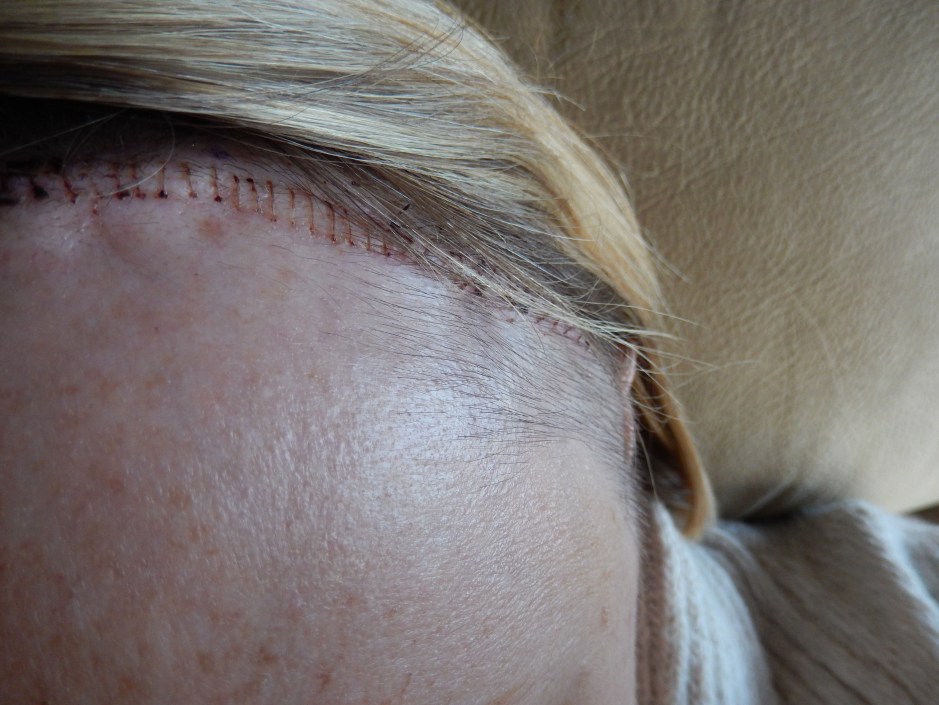
STITCHES/INCISION: I can feel the incision under my hair line and the hair has all grown back so that part isn’t even visible anymore. As the swelling went down and I lost a little bit of weight (20 lbs at one point), the bone flap area “settled” into the skull quite a bit and a dent has appeared. The pins and small plates that secured the bone flap back onto the skull area are also visible and sticking out under the skin on the skull and I most certainly feel them. I’m not crazy about the dent or the brain “bling”, but it is what it is and I doubt anyone but me would really notice them. Although when I have my hair parted differently and the light hits it just right, Dave will notice and always points it out. I’ve seen much worse dents on other survivors I have met, so in comparison, I’m lucky.
BRAIN FUNCTION:
Well, I have survived two more catalog seasons, so I guess my brain function is doing okay. I certainly feel tired at times, but I’m very, VERY lucky that I can drive, work, read, and function on a daily basis. I’m a little slower and a little more careful when walking and traversing walkways, hills or paths because I have a bit of a fear of slipping or falling and hitting my head.
I do still struggle with some survivor’s guilt. Why, dear Lord, am I so lucky with my multiple brain aneurysms when two (and possibly three) people I loved so much were victims of the same ailment? One can say because God has other plans for me to help others. If that’s the burden I have to carry, then so be it. I can’t say I’m crazy about it though. I’d rather have Kim, Dori, my mom and Rhonda back.
So, I will celebrate my clip-aversary in some fashion I’m sure. I’m glad I’m still here and I hope a few others are as well.
October has always been a bitter-sweet month for me and my family.
The Sweet:
my nephew Ian was born (he’s now a handsome 19-year old!)
my step-nephew Adam was born
my sister Dori was born
The Bitter:
my Dad was diagnosed with cancer in October (lost him in 1994 – 6-months after diagnosis)
my Mom passed away in October last year (2014)
my brother-in-law Fred was killed in October
I suffered a ruptured brain aneurysm in October in 2006.
And I’m sure I’m leaving something out, but those are the biggies. I think that’s enough, don’t you?
October 25th is a bitter-sweet day for me as well. It was Dori’s birthday, but it was also the day I was released from the hospital after a three week stay nine years ago next week. I remember speaking to Dori on the phone after I got home and she told me my coming home was the best birthday present I could have given her. We were both crying.
How awful that six year’s later, I was crying in a London hotel room after findiing out Dori had suffered a ruptured brain aneurysm too and I never got a chance to say good-bye and let her know how much I loved, and adored her.
Brain aneurysms simply suck. They take the lives of young, old, healthy, joyful people, and devestate the lives of those they love. Granted, they don’t always kill, but they certainly can cause distruption and change the lives of all those around you forever.
October is also a stressful month for me at work. With my rupture happening in the critical last weeks of catalog production, it was left to our small crew and a poor graphic artist brought in to pick up the pieces to finish the book. They did the best they could. Three months later I returned to work part-time to find my office with calendar’s still set on October and reminders on my computer for jobs that needed to be completed…in October. A surreal experience for sure.
I am one of the lucky ones who #1, worked at a great company that allowed me the time to heal and recover and #2, I was physically able to perform my job full time after a 6-month recovery period. Soooo many are not so fortunate and the needs of survivors and their issues after a rupture are so varied, it’s difficult for employers and co-workers to truly understand the depth of recovery needed.
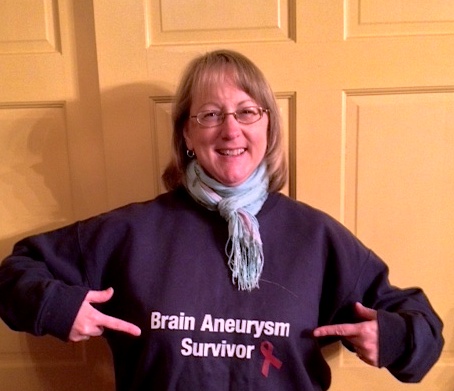
I suppose that’s one of the reasons I speak out about brian aneurysms and try to educate others. Although this blog as been theraputic for me personally, I have received a few comments from other survivors and those who have lost loved ones who tell me it has helped. That means more to me than any amount of money I could raise. Support is what we all need. I have survived a rupture, a coiling, a re-coiling and a stent, then a craniotomy on a 2nd un-ruptured brain aneurysm. And that first large brain aneurysm is STILL giving me issues. Look for updates on more potential “brain bling” in the New Year!
Every October I remember the day of my rupture. Every October I remember my mother’s death now. I remember my father’s diagnosis with cancer and I remember my sister’s birthday on October 25th. I still hate October, but I’m here. For whatever reason, I. AM. HERE.
Well, after meeting with my neurosurgeon this morning we have decided to kick the can for another year on the blood remnant in my large brain aneurysm. Yes, it’s there, but it doesn’t pose any immediate risk at the moment – they think.
Options currently presented are:
Do nothing and observe with periodic angiograms/MRA’s.
Insert more coils (I have 20 already) into the aneurysm in hopes no more blood gets in.
Block off the affected artery and see if the blood flow reverses.
Place the relatively new Pipeline™ Embolization Device INSIDE the existing stent that was place in the artery in 2011.
Here is how we’re addressing each option:
Watch & Wait: Simply monitor the remnant with periodic angiograms and/or MRA’s. Then if it appears it IS growing and more blood is getting back into the aneurysm, THEN we act. It could do nothing for 10 years, or it could double in size by next year.
More Coils: I already have 20 coils and a stent that is supposed to be blocking blood getting into the brain aneurysm. Obviously, they’re not doing their job as hoped and expected.
Sacrifice the artery where the aneurysm is & reverse blood flow: This procedure will require doing a balloon occlusion test first to determine if my vascular system can handle the blood flow being shut off. IF the balloon test is successful, then I would be a candidate for having that “diseased” part of my artery completely filled with coils and the blood flow would reverse. I’m still trying to understand how it all works.
The Pipeline inserted inside existing stent: The doctor had done some research and this specific procedure has only been done ONCE, at least in the U.S. that he is aware of. Not exactly a glowing recommendation. Even one of the most renowned neurosurgeon’s in the country has shied away from doing it.
It’s pretty safe to say we have ruled out options 2 and 4. Adding more coils doesn’t seem like a more durable option at this point and even though the Pipeline has been used VERY successfully throughout the entire country, including here in Maine by my doctor, the lack of data and positive feedback on inserting one into an existing stent doesn’t bode well for its use in my specific situation. I’d rather not be a test subject unless all other options have been exhausted.
So, we’re going to do a combo of 1 and 3. Well…at least #1 at this point.
Blood Supply To The Brain
I’ll have an angiogram next Spring AND have the balloon occlusion test done at the same time. There are four main arteries supplying blood to your brain. In most people, there are links between these four arteries that allow for one of the arteries to be blocked without significantly affecting the amount of blood reaching the brain. The balloon occlusion test is usually done if there is an abnormality (in my case, an aneurysm) in one of the four main arteries. It is a way to see whether one artery can be temporarily or permanently blocked without significantly affecting the level of blood in your brain. An X-ray and a special dye are used to create images of your arteries and a small balloon, which when inflated will temporarily block your artery. Sounds scary, but if you’re on the table in the hospital already, they simply deflate the balloon if you’re unable to handle it.
The angiogram will allow us to see if the remnant has grown in a year and we’ll have the balloon test done and that will determine, should I NEED to treat the remnant, that blocking the artery and reversing the blood flow is a good option. If I’m unable to handle the test, then that’s another option off the table.
There is another potential, more invasive option, but I’m not even going to go there yet. We’ll wait a year, see if the remnant has gotten any bigger, and DOES need treatment, before we address it further.
So, I’ll continue to eat better, try to get more exercise, and reduce stress……the last one will be the hardest I think. Kick the can….







 Heidi's Brain Blog