Tonight was my first time back to our brain aneurysm support group meeting since probably last September, possibly August. During catalog season I’m always working late and far too tired to go anywhere during the week. Ironically, fatigue and memory is a common theme at many of our meetings as it was tonight.
As always, it was good to see returning faces and I missed a few who weren’t there. We’re getting a nice “core” of survivors, care-givers, and those who have lost loved ones. The support is always there and we all try to listen to each other’s stories and offer validation for feelings and emotions that only those who have gone through the same thing can appreciate.
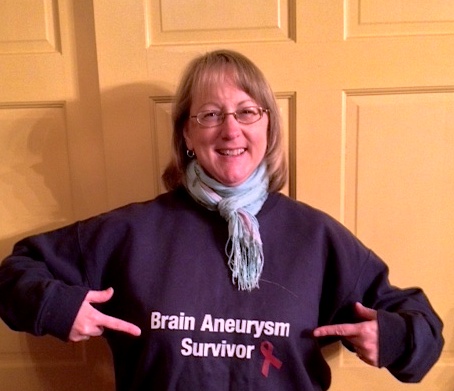
Unfortunately, I’ve had the brain aneurysm double-whammy; I myself, have suffered a ruptured brain aneurysm, and I have lost two loved ones to ruptures. I’ve seen both sides of the caregiving aspect, or those left behind, and I’ve also been a part of the survival and recovery part. Each part has struggles and pain.
Tonight, a father shared the story of the night his adult son’s brain aneurysm ruptured. It was a violent rupture and if he had been home alone, he would not have survived. His wife was able to revive him briefly – twice. He survived surgeries and a little bit of rehab and multiple rounds of different medications. He was at our meeting tonight while his father described the night it all happened to us. Even though his short-term memory has basically been lost, he cannot work or drive, and his family continues to endure a level of frustration and pain I cannot even begin to understand for several years now. But he IS alive, walking, talking, and able to function in some capacity.
Hearing a caregiver, and a father, talk about what happened that night, was difficult for me. My sister and Dave’s niece went through very similar experiences….or we can assume. My mind immediately raced to Dori’s rupture and how she lost consciousness on Mother’s Day and her husband was able to revive her while their 15-year old son called 911. But by that point it was too late. The damage from the rupture had already been done.
Then I thought about Kim, who was home alone when her rupture occurred. I can only hope and pray it was quick, but I also always wonder if someone had been there and found her sooner, if she’d be here today and if she were, what kind of life would she be living. The severity of her rupture and the location of it, leads me to believe Kim would not be the same person if she had survived. The same can be said for Dori.
We witnessed tonight the amazement in seeing a survivor of such a devastating rupture, but also the heart-wrenching pain in knowing their loved one will never be the same. That they can no long take care of themselves or their children. That they need major supervision. That they need to be reminded of things on an hourly basis to get through the day…yes, they DID survive, but in a sad way, they’re only a shell of the person they once were.
Is it only by the grace of God, that I am here today? Why did I survive and they did not? Why did I survive with very few deficits when others have continued issues and pain, even years after their ruptures?
I don’t like it when I come away from one of our meetings with these kind of questions. I should just be grateful and keep my mouth shut and never complain about anything, ever again. I AM one of the lucky ones…or one of the chosen ones…or just a person who was in the right place at the right time, with the right set of doctors. Fate? I don’t know.
I suppose those are all questions that will have to remain unanswered. Kind of like “Why doesn’t Fred Flinstone have horribly bloody feet when he has to stop his rock car with his heels?” Why? Why?
On the anniversary of my ruptured brain aneurysm in 2006 and subsequent coiling, I call it my “Annie-versary” stealing the phrase from other survivors from the Brain Talk Community online who helped me through my recovery. For some reason I feel I need to give my 2nd brain aneurysm procedure (the clipping) a different annual name. Like I’ll be criticized for calling that an Annie-versary too? LOL I doubt it, but I do.
Saturday is the two-year anniversary of the clipping on my second, unruptured brain aneurysm. It turned out to be a delicate aneurysm and it was a delicate time. I had lost my other sister just a few weeks prior to my scheduled surgery and I was wrestling with whether I should go through with the surgery or not. It wasn’t until my niece and mother (who we lost last year) spoke to me and encouraged me to proceed, that I made the final decision to keep the date and proceed. I truly didn’t want to put them through anymore.
I think some angels were watching over me because it was a good thing I DID get the craniotomy & clipping. It was an ugly, thin-walled brain aneurysm that would have surely caused me issues, if not caused my death, at some point down the road.
For my two-year update I’ll recall an earlier format I used to update my family and a few friends on my blog about my recovery process.
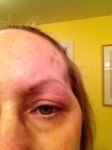
FATIGUE:There are still days I KNOW my brain had too much stimulation. It’s difficult to describe other than my brain is tired. I suppose that is something that will never go away. It does get better, but I’ll be able to realize when I need to rest my brain. Not just sleep, but do nothing…think about nothing…just nothing. I need those days still. I also notice my left eye lid will get a bit droopy when I’m overly tired and haven’t eaten much.
PAIN: These days, the only pain I feel that is associated directly to the clipping is on the left side of my skull. I have no idea what triggers the pain and I often have difficulty laying on the left side of my head. It “feels” like my brain shifts to the left against my skull and there is pressure there. It’s not a daily pain, but I certainly notice it when it is bothering me and I have to roll over and lay on the right side. Sneezing doesn’t bother me, but coughing really does. I feel it throughout my head and it makes me tired.
NUMBNESS: As many people said, including the Dr., this may or may not go away. The skin on my skull hasn’t completely “reconnected” all of the nerves, so a great chunk of it is still numb. I only notice it when others touch my head now. My hair dresser or Dave. At least it’s not painful….just odd. I certainly could have worse issues, so I consider myself lucky.
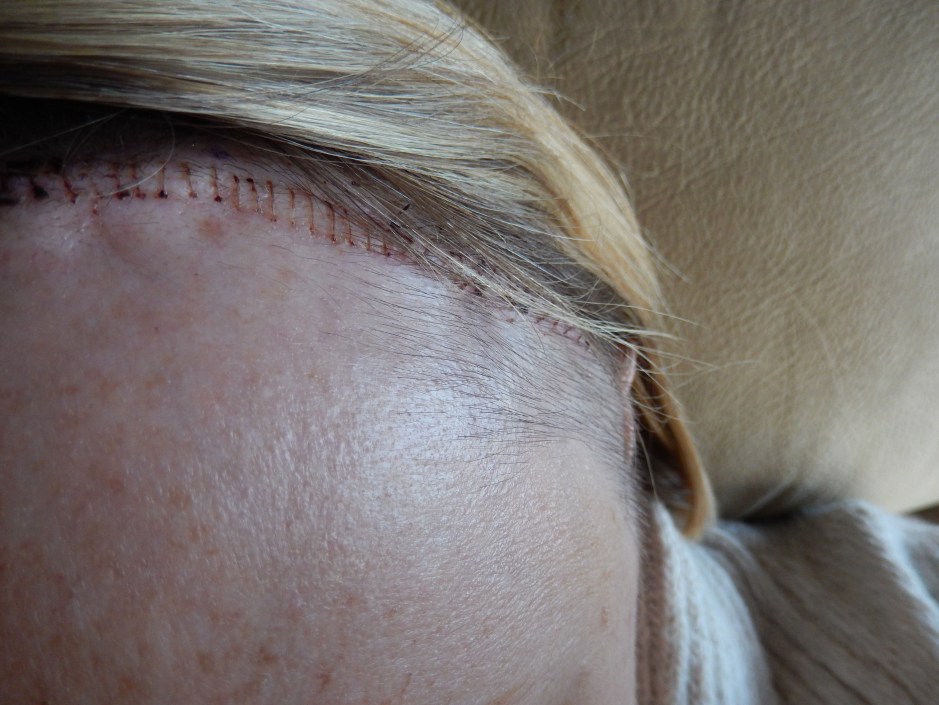
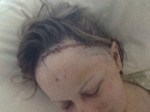
STITCHES/INCISION: I can feel the incision under my hair line and the hair has all grown back so that part isn’t even visible anymore. As the swelling went down and I lost a little bit of weight (20 lbs at one point), the bone flap area “settled” into the skull quite a bit and a dent has appeared. The pins and small plates that secured the bone flap back onto the skull area are also visible and sticking out under the skin on the skull and I most certainly feel them. I’m not crazy about the dent or the brain “bling”, but it is what it is and I doubt anyone but me would really notice them. Although when I have my hair parted differently and the light hits it just right, Dave will notice and always points it out. I’ve seen much worse dents on other survivors I have met, so in comparison, I’m lucky.
BRAIN FUNCTION:
Well, I have survived two more catalog seasons, so I guess my brain function is doing okay. I certainly feel tired at times, but I’m very, VERY lucky that I can drive, work, read, and function on a daily basis. I’m a little slower and a little more careful when walking and traversing walkways, hills or paths because I have a bit of a fear of slipping or falling and hitting my head.
I do still struggle with some survivor’s guilt. Why, dear Lord, am I so lucky with my multiple brain aneurysms when two (and possibly three) people I loved so much were victims of the same ailment? One can say because God has other plans for me to help others. If that’s the burden I have to carry, then so be it. I can’t say I’m crazy about it though. I’d rather have Kim, Dori, my mom and Rhonda back.
So, I will celebrate my clip-aversary in some fashion I’m sure. I’m glad I’m still here and I hope a few others are as well.
A fellow brain aneurysm survivor posted on Facebook tonight that she had fallen and hit her head pretty hard. After a CT scan, she was given the “all clear”, but I know it must have been scary. She has been through multiple procedures and suffered a stroke.
This week I celebrated my 9th Annie-versary: nine years ago I suffered a ruptured brain aneurysm. The 11mm (almost 1/2 inch in diameter) aneurysm I didn’t know was growing inside my brain suddenly ruptured. The annie-versary day went by with little fan fare. My husband made me dinner, which is always a special treat, but beyond that, because I’m always so busy at work, I didn’t do much to celebrate.
The first couple of years, I would take the day off and have a spa day. I think I need to start doing that again…regardless of how stressful & busy things are at work this time of year…which it always is. They’re lucky to still have me.
Falling and hitting my head is probably my biggest fear. I hate it when I get to work late and have to park up on the very steep hill parking lot. I always fear falling down and make sure I grasp and have a good hold on the PVC pipe railing along the “side walk” up and down the hill. The railing is always covered with snow or ice too, so not sure how much of a help that is.
I probably didn’t share this with many people, but on our last night in Scotland in 2013, our tour guide dropped us off at a hotel near the Edinburgh airport. Dave and I enjoyed a lovely dinner in the hotel restaurant, then I REALLY wanted to take a long soak in a tub and there was a deep, soaking tub in our room at the hotel. As I was getting out, I misjudged the height of the tub to the floor and slipped on the tile floor as I got out, BARELY missing hitting my head on the tub and landing on my backside pretty hard.
Dave immediately ran in from the other room. I was laying on the floor with my head pretty much laying up against the tub. Once we both realized I was okay, we both shook in fear. It was a scary moment and one I hope never to repeat. And that was before I had my craniotomy on my 2nd brain aneurysm.
I suppose the fear is that a hit on the head could produce some sort of shock on the aneurysms and force them to bleed. Or that the surgical work that has already been done…could become “undone”. I’m not even sure how realistic that fear is. I supposed I should ask on my next visit with my neurosurgeon. Because I’m susceptible to aneurysms and bleeding, I would think any hard hit could be a risk. So, I’m very glad Lori got a CT scan after she fell and hit her head. I’d do the same thing.
I didn’t hit my head when my first brain aneurysm ruptured in 2006. No warning, no symptoms, that I recall. But I know that brain hemorrhages can occur when hitting your head. The tragic death of Natasha Richardson is a sad example of that.
So, nine years ago this week, I was in the ICU at Maine Med, then moved to the 608 Neuro-ward. I was in the hospital for two weeks then had six months of recovery before going back to work full-time. Only one person from work visited me and it was simply because she was in the area. I’m so glad Lori has such a wonderful group of friends to support her. I’m sure this fall scared her very much. I know her daughter and husband keep a close eye on her and I’m sure THEY were just as scared as she was. Her service dog Tober will make sure she’s okay. What a great dog he is. Love him.
I’m a NASCAR fan, and the race at Charlotte, NC is this weekend. I remember watching that race in ICU with Dave and my sister Dori (who died of a ruptured brain aneurysm in 2012). They were impressed I knew the drivers and was so responsive. I was one of the lucky ones. Some times I wonder WHY I was one of the lucky ones when so many beautiful, vibrant people who had children to live for aren’t here anymore. It just doesn’t make sense some times. Survivor’s guilt? You bet cha. I’m not a mother and I think I’m a very selfish person, so I’m not sure why God chose ME to live over all of the other beautiful, strong individuals who have lost their lives and devastated their families over ruptured brain aneurysms. It just doesn’t make sense to me some times.
So, yes…I walk slower in snowy & icy conditions. I drive slower in snowy & icy conditions. I don’t ride a bike anymore because of the fear of falling off and hitting my head. I don’t do any strenuous physical sports anymore…not that I ever did before. Falling and hitting my head can happen at any time…even slipping on some of the acorns in the driveway, which is like walking on marbles, gives me pause. I bought this fear up at a support group meeting, but I was on the only one who addressed it. I’m sure other’s have that fear. I’m so glad Lori is okay after her fall. Aneurysms survivors have another added fear. Goody….but I’m still here.
The 2015 KAT-Walk & Karo-5K for Brain Aneurysm Awareness was held this past Saturday and the weather Gods, or at least our angels we call Kim & Karolina, were on our side.
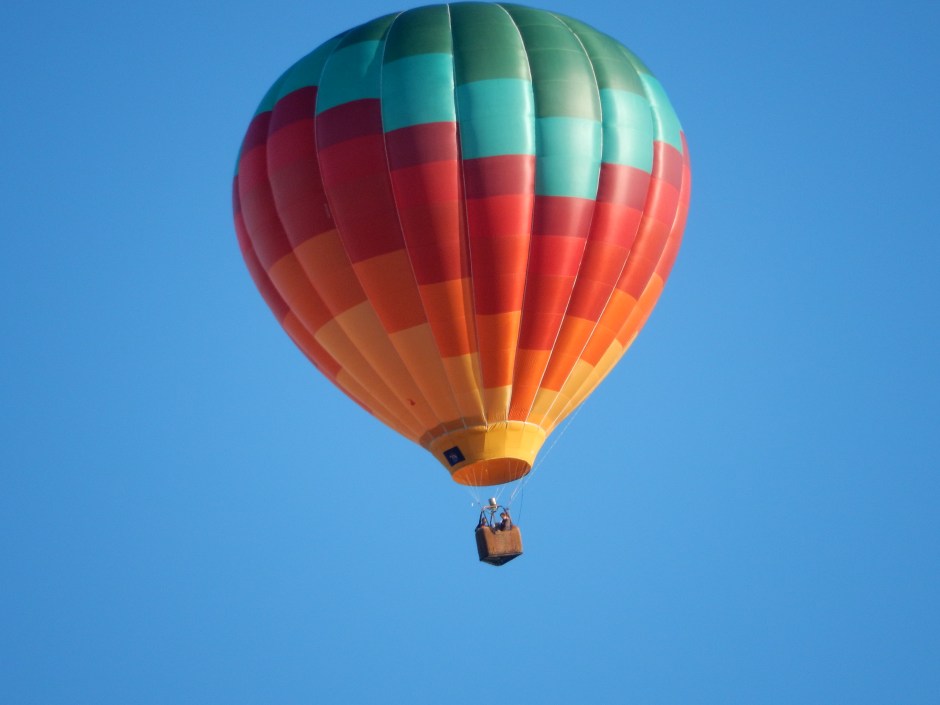
The gentle rising of a hot air balloon greeted us.
We arrived at the Back Cove to see the sun come up, and as we were unloading the trailer, I noticed a hot air balloon slowing rising above the horizon across the bay. I had to stop and take a photo as I didn’t know which direction it was going. Thankfully, it glided right over our location and provided a stunning view of the extremely colorful patterns. It was fitting the bright colors were in our array of colors; the teal blue for Kim, the red for Karo, the orange for Nolan and blue and white for Scotland! 🙂
We were extremely blessed by warm, but not hot temperatures, low humidity, no rain and light winds. Some years the high winds can cause major issues with the tents, printed collateral, and flags.
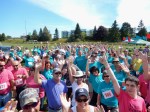
The event was physically moved down to a location along the trail that allowed us to see more of the people involved. The previous years we were set up in a row along the gravel trail. Last year, we had no idea there were over 600 people there until the 5k started and they all gathered in one place. Once they registered, they became all spread out until that point. This year, our hope was to provide an area where the teams, families, and friends could gather and continue to be a “part” of the day with everyone else. I think we succeeded in that respect and some very positive comments were shared.
I’m usually set up in the Brain Aneurysm Awarenesstent and get to meet survivors & their supporters who are new to the event and welcome those who have returned. We also try to provide comfort and support for those who have lost a loved one. I know we celebrate those who survived, but we also try to remember the reason many of us are there is because we lost a loved one to this silent killer. We did have a tender moment of silence to reflect on those lost in the opening ceremonies and many people use the honor board to gather and take picture’s with their loved ones sneaker.
Another good thing about moving the venue location was having the Start/Finish line directly in the vicinity of our tents. Those who finished early, could continue to be apart of the event and still cheer on those who crossed the line because it was right there.
Because Dave is so familiar with so many of the families and participants through his direct personal contact with them, he knows so many of the runners, walkers and their supporters. So, as he started to see some of them come across the finish line, he grabbed the microphone and started announcing them. I think that added a real special, personal touch. I know it was nice to have my name mentioned as I crossed the line all by myself again. Heidi McCausland….team of one!
The Board of Honor where sneakers with a survivor’s name or one who was lost are placed.
Usually the most heartwarming and heart-wrenching parts of the day are when we meet random people who are coming to the event for the first time and are reluctantly coming to the tent to read more about brain aneurysms and who want to write their loved one’s name on a sneaker to add to our Honor Board. I met one women who was there to walk for her best friend whom was lost 6 years ago. This was her first time there and it was very emotional for her. I hope participating in the event and honoring her friend in such a way helped comfort her.
I also met another woman who had lost her sister two years ago and was just walking by and saw the signs for the event. She didn’t participate in the event, but came to our tent, signed in, made a sneaker out for her sister, and took a brain aneurysm awareness bracelet. No matter how we reach out and connect, it’s all important.
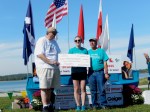
Last year’s event, which raised a record amount of money, helped fund a $25,000 Chair of Research through the Brain Aneurysm Foundation. The recipient of that award made the trip to our event to honor US and to participate. Not only did Dr. Kimberly P. Kicielinski make the trip from Alabama, via Houston, then Boston, but she participated in the 5K, received honors from our committee, made a speech, and then she and her boyfriend Justin helped tear down the event afterwards and joined us for an after-event party.
The work Dr. Kim is doing is very important. She is trying to determine the thickness and fragility of artery and aneurysm walls. Exploring this issue could result in saving many lives. If doctors are aware an aneurysm is at higher risk of rupturing due to a weakness in the wall structure, they could act and operate and save a life before a potential catastrophic rupture occurs. Dave had some wonderful communications with Dr. Kim via email prior to meeting her in person at the event and things she said and obviously has done and is doing, really struck a chord with our entire committee.
For me personally, after my 2nd unruptured brain aneurysm was clipped in January, 2014, the doctor said we dodged a bullet because the aneurysm itself was very oddly shaped and had a weak point at the top of it: something they weren’t able to determine UNTIL they opened up the skull and had physical contact with the aneurysm. Dr. Kim’s work could provide that information before they go into the skull. If I hadn’t made the preventative decision to have that surgery, it could have killed me…and sooner, rather than later.
I left the shade of my tent to participate in the 2-mile walk this year. I walked alone again. Many people pass me, some are way behind me, but I finished and was proud. I walked for myself, my sister Dori, Dave’s niece Kim, for my fellow survivors who couldn’t join us this year, Lori & Julie, and for all those who don’t have the support of co-workers, friends, or even family members.
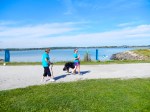
The trail is a beautiful spot for a walk/run and Dave is always insistent that there be high tide during the event to provide the best possible view. Trust us…you don’t want to be walking there when it’s low tide. LOL Just not pleasant. The flags were waiving, the surf was light and the seagulls were chattering away.
Two special guests were Christine Doherty Kondra and Alison Sedney from The Bee Foundation, a national organization focused on research for brain aneurysms. It was wonderful they made the trip up from Philadelphia to join us and speaking to them reminded me of how important the national dialogue on brain aneurysm awareness is. So many people don’t know what a brain aneurysm is until they, or someone they love, is affected by it. Alison lost her daughter, Christine’s cousin, on Christmas day to a ruptured brain aneurysm and just like all of us who participate in the event on Saturday, she too, has decided to DO something. The efforts of The Bee Foundation not only raise awareness, but provide critical medical research. It was great meeting them.
Every year we try and try to get some local television coverage of our event. Local news can cover a story such as the new Passy Pete, the lobster that can predict six more weeks of summer, but we’re unable to get them to cover our event? I just don’t get it and it’s very, very disappointing and depressing.
However, this year committee member, and co-founder of the KAT-Walk, Art Piteau, did a wonderful radio interview that aired the morning of the walk on the Derek Volk Radio Show on WLOB radio 1310. We will definitely use this resource in the future and Art did a great job on a subject he’s very passionate about because he adored Kim and was a large part of her life. HEAR AUDIO INTERVIEW>
We were also blessed to have a wonderful article written by Harrison Thorp for The Lebanon Voice newspaper. He was at the event with his partner Martha who was a very recent brain aneurysm survivor having had a craniotomy and clipping just a few short months ago. They both participated in the walk and gave a heart-felt report on the day’s events including the story of one survivor, Deb Hanmer, who is source of inspiration for many of us. It was wonderful to get a new participant’s perspective. READ ARTICLE>
Overall the event was successful in my eyes. We had a tremendous group of volunteers this year which made set up and tear down so much easier and even, dare I say, enjoyable! Thank you to everyone whose tireless efforts provide a beautiful, personal, and productive event. BRAVO!
Unloaded and ready for setting up
The gentle rising of a hot air balloon greeted us.
Floating directly over head
Aneurysm awareness ribbons and bracelets
Stunning day!
Our centerpiece
The Wall of Honor
Excited to be there.
Walkers around the cove
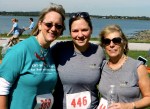
Myself, Christine & Alison from The Bee Foundation
Inspirational survivor, Deb Hanmer
KAT-Walk & Karo-5K Chair of Research recipient Dr. Kimberly P. Kicielinski








 Heidi's Brain Blog