More Brain Bling?

This morning we met with my doctor to discuss the results of my angiogram, his findings, his recommendations, and the next course of action.

FINDINGS:

  • In comparing the most recent angiogram with the angiogram from 2016, there are “significant changes” in the bloody remnant in the neck of the aneurysm.
  • This finding gave my doctor “anxiety that it is at risk” of rupturing in the future again.

RECOMMENDATIONS:

  • Place a flow diverter inside my existing stent to prevent more blood from getting into the neck of the aneurysm.
  • They may insert and expand a balloon first to push back any “tines” from the original stent to allow the new flow diverter to be positioned better.
  • The Surpass flow diverter is a more flexible stent that should adhere better to my “ugly” and “challenging” arterial structure around the aneurysm.
  • It’s an endovascular procedure, so not open head surgery.
  • Bringing in an additional doctor with knowledge of this procedure and flow diverter to assist if need be.

MY DECISION:

  • To go ahead with this procedure here at Maine Med.
  • Will be put on blood thinners (Plavix and full-strength aspirin) the week prior to procedure then remain on both for 6-months after.
  • Procedure could be as early as March.

There is a good video about administering the Surpass flow diverter on this page, although it doesn’t show it being deployed inside another diverter: Surpass Flow Diverter

I was surprised to read on my blog that I’ve been dealing with the stress of this darn remnant for 11 years now. When the re-coil and stent didn’t do the job, the next course of action would be the stent within a stent. If THIS doesn’t work, there is a possibility we could sacrifice that entire section of artery, but I’m counting on it working so let’s not even go there.

Making this decision with Dave by my side gave me a sense of relief. Relief in knowing I’m doing something about it and there is a plan of action. I have great faith in my doctor and his familiarity with my case, my brain, and this particular brain aneurysm for the past 11 years. I know he wouldn’t make a recommendation unless he felt there was a good chance of success. And so far, he hasn’t been wrong.

The Thing that Won’t Go Away

The follow-up with my interventional radiologist/neurosurgeon confirmed the MRA I had in December showed additional development of more blood getting into the neck of my first brain aneurysm – AGAIN. We went through these discussions back in 2015 when that remnant first showed up. I decided to kick the can and watch, wait, and continue to monitor it. After five years, it appears there is more blood now.

The doctor wants me to have another angiogram to get a closer look and determine if we need to take action now. This is not the way I had hoped to start the new year. It may be nothing alarming…or it might be.

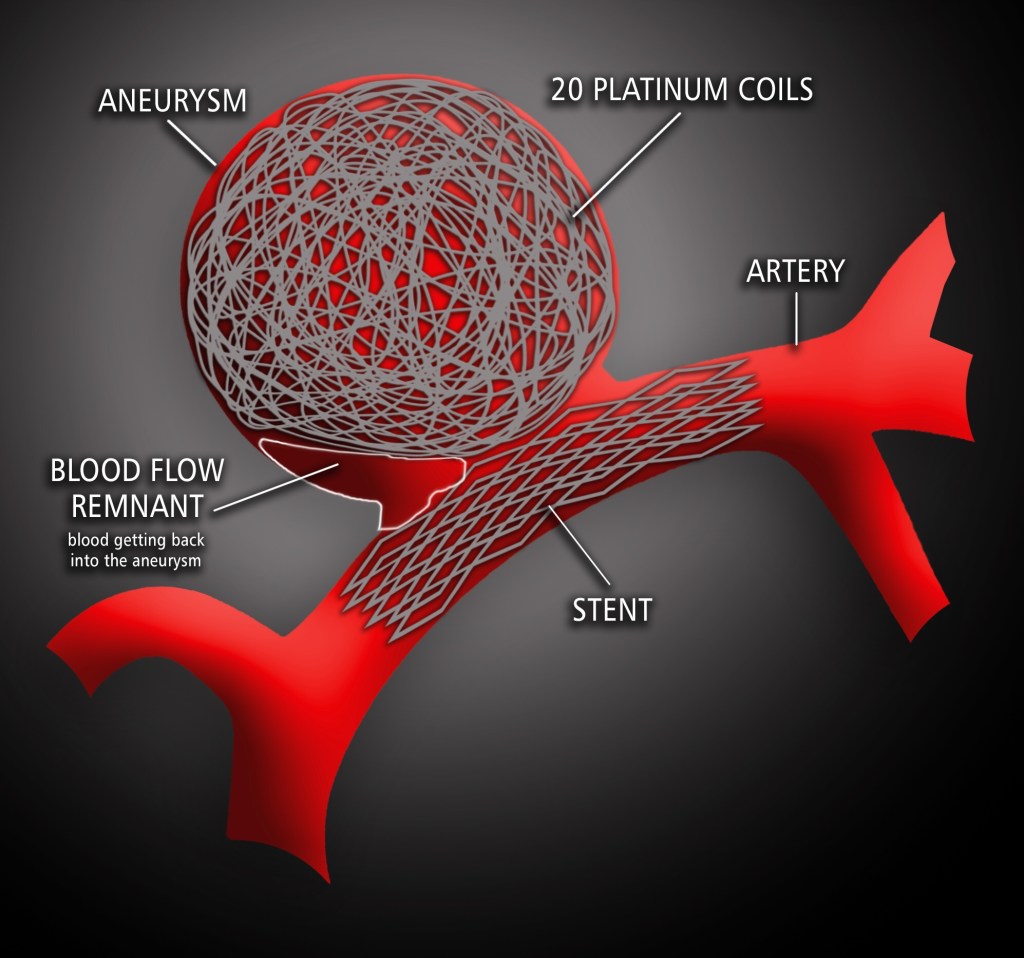
I created the graphic below to present, in it’s simplest form, what’s happening. This is the first aneurysm that ruptured in 2006. It’s 11mm or about 1/2” in diameter.

  • There were 16 coils inserted into the aneurysm in 2006.
  • Those coils healed and clotted, preventing blood from getting back into the aneurysm.
  • Five years later, the coils either started to compact, the shape of the aneurysm and neck of the aneurysm changed, or a combination of both occurred, This allowed some blood to get back into the neck of the aneurysm.
  • 4 more coils were inserted (for a total of 20) and a stent was placed across the bottom of the neck in the artery in 2011.
  • In 2015, during annual checkups, it was discovered more blood was starting to get back into the aneurysm again.
  • We decided to “wait and watch” the remnant of blood for future development.
  • Now in 2022, we’re discussing the fact that it appears MORE blood is getting into the aneurysm after six years of stability. This is also a brain aneurysm that has already ruptured once.

During the last 15 years, I have had to endure a couple of “watch and wait” periods for both my aneurysms. There is always a nagging worry that lays there asking those probing questions: Is it growing? Has there been any change? Am I making it worse? Could something I’m doing make it rupture? Is that headache a sign that something is wrong?

Anyone who is living with brain aneurysms knows that worry. Telling me to “Not worry about it” is far easier said than done.

The good news is that I feel fine. I just hope I can stay that way. 🤞

I Am Lit

As I get prepared for my 2-year follow-up MRA this Friday, I was curious to see just how many angiograms and MRA/MRI’s my brain has had since 2006. Thankfully, I was able to get a pretty good handle on that number by simply searching this blog. I was surprised by the number…but not really.

CEREBRAL ANGIOGRAMS

I have had NINE cerebral angiograms which include three treatments that are performed using this same process: my initial coiling, then my stent placement, and recoiling were all performed using angiography.

A Cerebral angiography provides x-ray images of blood vessels in and around the brain, showing abnormalities like brain aneurysms.

PHOTO: John Hopkins Medicine

Typically a catheter is inserted into the femoral artery in the groin and threaded through the circulatory system to the carotid artery where contrast die is injected. A series of images are taken as the contrast agent spreads through the brain’s arterial system, then a second series as it reaches the venous system.

MRA/MRI

I have also had SEVEN MRA/MRI’s. Magnetic resonance angiography–also called a magnetic resonance angiogram or MRA–is a type of MRI that looks specifically at the body’s blood vessels. Unlike an angiogram, which requires inserting a catheter into the body, magnetic resonance angiography is a far less invasive and less painful test.


PHOTO: My brain bling via MRA imaging.

The frequency and type of follow-up procedures I receive hinge on the previous scan showed and what procedure was provided. We’re hoping I can continue just getting MRA’s, but if something unusual shows up, more angiograms may be needed. Angiograms are more invasive and risky, but they are the gold standard for getting the clearest images of my blood vessels.

I am blessed to have had such a great neuro team here in Maine and terrific health insurance coverage through work.

Here’s to more scanxiety.

All The Bling

I have often referred to the hardware in my brain as my “brain bling”. It’s not a term I came up with myself, but stole from another survivor. I’ve always considered my brain bling to consist of my 20 coils, 1 stent and 1 clip. Basically, metal that is keeping me alive.

But wait, there’s more! I keep forgetting I have more metal in my head in the form of the plate and screws used to hold my bone flap in place.

The 20 coils and stent came first, then the clip via a craniotomy came after. A craniotomy is a type of surgery that removes part of the skull (a bone flap) to access the brain underneath. When the procedure is complete, neurosurgeons put the bone back in place and secure it with tiny plates and screws.

With my fingers, I can feel the plate and screws under my skin, and at certain angles and lighting they’re very visible sticking out slightly under my skin. The much more visible aspect of most people’s craniotomies is the “dent” or a skull compression that can occur.

The dent is a common occurrence due to the refitting of the bone flap. It is impossible to reattach the bone flap for a snug fit, for any number of reasons. Therefore, a space is created between the two bone surfaces and fitted as closely as possible. The bone is reattached and secured with the plates and screws to ensure very little movement and easy surgical access if it is necessary. However, the piece of bone can shift slightly and create that indentation.

They can use synthetic fillers to restore the normal contour around the dent, but I have opted not to have it. It just makes me nervous having something injected around that area. I pretty much try to cover my dent with my hair. I’m not horribly self-conscious about it (if the wind blows my hair up….THERE it is!), it’s just not that attractive. So, as long as I have bangs, why not use them to cover it up, right?

My Actual Brain/Head Bling Count:

  • 1 Titanium Plate

  • 2 Titanium Screws

  • 1 Titanium Clip

  • 1 Stent

  • 20 Platinum Coils

And no, I do not set off the x-ray machine at airports.