This Year’s Angiogram

I’m seriously hoping this is my last angiogram for awhile. I’ve seen that angriography suite far too often the last several years. However, it’s the best way to see what’s really going on with my pesky vascular system.

As stated in my previous blog entry, this angiogram was to determine if there were any changes to my original 11mm brain aneurysm from last year when it was discovered more blood was starting to creep back into the neck of the aneurysm. Obviously, the 20 coils and the one stent weren’t doing the best job they could be, but I’m still here.

Since there was a chance I’d be staying overnight, I had to go to admissions first and check in, then we went straight to the radiology department. They were quite busy today, although I reminded myself I’m usually scheduled for much earlier appointments. This is the first time I’ve had an afternoon appointment and I was VERY hungry and thirsty after not having anything to eat or drink since midnight the night before.

Upon entering radiology, Dave and I were greeted from a distance by nurse John, who we usually see when we arrive there. It’s a mixed blessing when you’ve visited a place so often you become so familiar with the staff of a hospital. John told my attending nurse that I didn’t need any instruction because I knew exactly what I was supposed to do in here. LOL Yes…pretty true.

The IV was hooked up, more questions were asked, and more instruction was given. We were most curious about the balloon occlusion test and what that entailed.

The BOT is a little more risky and it would also require another port and catheter into my other arm where something would be injected to bring my blood pressure down during the test. I wasn’t looking forward to TWO catheters. Dr. Ecker explained the risks and why they’d keep me over night as more of a precaution. If I was doing great after the whole thing I could potentially go home and not have to stay.

I said my good-bye’s to Dave and was wheeled into the radiology angiography suite. As usual, the teams assembled for every single angiogram I’ve had at Maine Medical Center are top notch and always make me feel comfortable and at ease. Even though I’ve gone through many of these, it’s still a nervous time.

They allowed me to request a music station on their Pandora internet radio that was piped into the suite. I chose 80’s Throwback music. As the doctor walked in he said the music was a step up from the morning sessions. I said “You’re welcome”.

So enough of the pleasantries and on to the drugs, please! I’ve always had some pretty good pain when the catheter in my groin is inserted and I always request a little extra something special. Thankfully, they complied and it wasn’t too bad. They also inserted the IV into my left arm to prepare for a catheter for the balloon occlusion test. That was a little painful as well, but it didn’t last long.

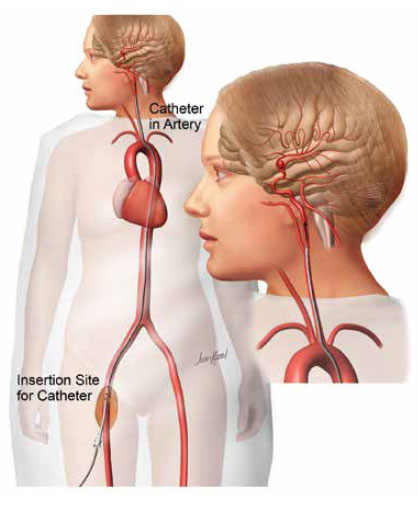
I know many people don’t understand why my groin hurts after having X-rays done on my brain. Aren’t they a tad far away from each other? Well, yes, but inserting a dye into that area gives a direct flight into the brain via one of the main cerebral arteries. I’m not sure why it’s going from the groin and not up higher on the body, such as the neck or chest, but it works, so I’m not going to question it.

image
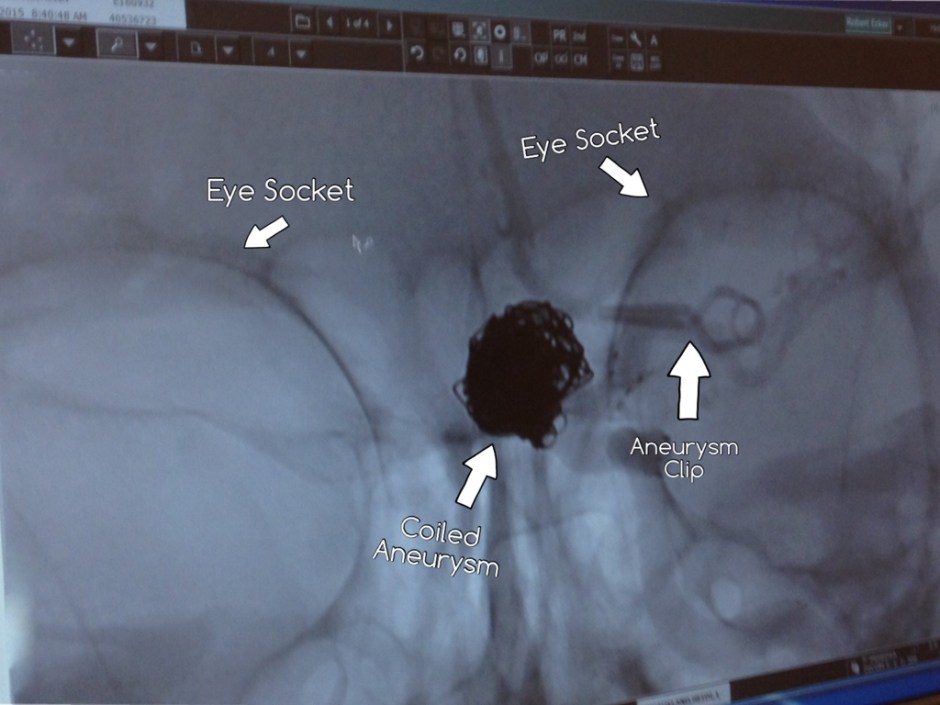
During the angiogram, they take a series of images of the arteries then inject a dye to see exactly where the blood is flowing and take another series of X-rays. When the dye is injected I see a series of small horizontal lightning strikes behind my left eye. It’s brief, but weird. I keep my eyes closed during the whole thing, mainly because I’m dopey and can’t see anything without my glasses anyway, but because there is usually part of the machine directly above my head and there isn’t anything to see anyway.

After the initial angiogram, Dr. Ecker compared images taken last year at this time with the ones he just took. He was able to pull them up on the screen side-by-side, then even overlap them. He indicated there was absolutely NO change from last year, which was great news. Then he was questioning if we should even go ahead with the balloon occlusion test at that point since nothing had changed.

The main reason we were going to do the balloon occlusion test in the first place was to see if my vascular setup could even handle such a reversal of blood flow should a I NEED to have something dramatic done to prevent more blood from getting into the brain aneurysm.

Since there didn’t appear to be any immediate need for that, based on this angiogram, we both decided to forgo the BOT this time. I was okay with that. I wasn’t looking forward to more pain, or an overnight stay. However, a part of me was disappointed we just didn’t do it and get it over with now so we’ll know down the road.

Because they had expected to do a lot more, the large team assembled for this big event wasn’t really needed now and the last thing remaining in the radiology suite was the dreaded “plug”, or Angio-Seal™. The angio-seal is a small device that basically closes up the puncture site in the groin. However, since he used a larger catheter for today’s procedure, that larger plug was needed. It can be quite painful, mainly because I’ve been “poked so many times” as he said. Lucky me!

Why, yes…it WAS painful and they had to tell me to calm down, relax, and keep my leg down. I did. Still hurt. LOL The UPSIDE of using the closure device is that I only have to lay flat in recovery for two hours, not four or more hours if they were simply to apply preasure to the site for 15 minutes. The angio-seal allows the bleeding to stop much more rapidly and a quicker discharge from the hospital So, that’s the trade off for the pain.

image
The seal is comprised of three absorbable components: a small anchor, collagen, and a suture. The doctor guides the anchor through the hole created during the procedure where it is drawn in against the wall of the artery and the suture and collegian compact to create a secure seal over the entry point in the groin. All three components dissolve and are absorbed into my body in about 90 days. I’ll have an odd bump there for awhile, but the pain should ease after a few days.

The recovery in the radiology department is always long, but it seemed more so this time because they kind of forgot to offer me any food or water. It wasn’t until Dave asked them about an hour into my stay that I got a sandwich and some water. That’s highly unlike that crew and I was a little surprised.

Once they had me up on my feet for a short walking test and determined I wasn’t dizzy or unstable, I was discharged and walked out on my own. The only stop on the way home was at McDonalds for a shamrock shake! ‘Tis the season and it tasted sooooo good.

I developed quite a nasty headache on the ride home and was very glad we didn’t live any further than the 60 miles away we already did. The second I got in the door I had a cold cloth ready, heated my beanbag neck wrap, and crawled into bed for a good 7 hours. All the while keeping a pillow over my groin area so the cats wouldn’t jump directly on it. They did very good….been there, done that and I think they knew mommy wasn’t feeling well and cuddled with me all night.

My sleeping and eating pattern is all out of whack now and my groin is still giving me some pain. I’m pretty tired and not real stable. My head is going back and forth on whether it wants to bother me or not, but nothing I can’t handle. I’ve been in worse pain, been in worse condition, and I’m just lucky to be here.

However, there still is that lingering “issue”. Blood has gotten back into my original brain aneurysm and it’s still sitting there. Dr. Ecker wants me to get an MRA so we have a really good baseline image as it stands right now, then we’re hoping to just have MRA’s next time and not have to go through an angiogram as frequently. I’m all for that. Not that I enjoy MRA’s, but it’s far less invasive than angiograms, just loud and annoying. Then if they notice a change on an MRA, another angiogram will be ordered for a closer look.

I came away from this angiogram with mixed feelings. Yes, it’s great news that things hadn’t changed from last year, BUT there is still blood sitting there in the neck of a brain aneurysm that has already ruptured and we haven’t really resolved what to do with that. It’s almost a deja vu of last year. Something I guess I’ll still worry about until we see otherwise one way or the other. I don’t feel like I’m out of the woods yet from that pesky 11mm brain aneurysm. I should give it a name…any suggestions? (Keep it clean!)


The Continuing Adventures of an 11mm Brain Aneurysm

In our last episode of The Adventures of an 11mm Brain Aneurysm, our pesky friend was allowing what appeared to be more blood into the neck of the aneurysm. After 16 platinum coils were inserted in 2006, then four more coils and even a stent were inserted in 2011, blood continues to find its way into the 1/2″ diameter aneurysm that almost cost me my life in 2006.

When we met with Dr. Ecker last year, I made the decision to wait another year and see how things looked. Well, the time to have a look is near.

On March 2nd, I will have an angiogram to see if that area on the neck of the aneurysm has changed or not. It might look the same, or there might be more blood accumulating and action would need to be taken since it is an aneurysm that has already ruptured once.

I’m used to the angiograms. I’ve had so many since 2006. I know many of the radiology folks at Maine Medical Center now. They’re great, but I do wish I didn’t have to see them so frequently.

Balloon Occlusion Test
Balloon Occclusion Test

However, during this year’s angiogram, I will also be given the balloon occlusion test I talked about in last year’s post. They test to see if my arteries can handle reversing the blood flow in that area in case they have to perform a bypass where the parent artery must be sacrificed and the blood flow bypassed for the aneurysm to be effectively treated. I got into a little more detail on last year’s post. Until I know we’ll NEED to do that procedure, I won’t get any more detailed just yet.

The first two steps are to get some pictures of the aneurysm, then see if I can handle the blood flow being cut off to that part of the brain. Sounds scary….and yes, I am scared, but I’d rather have it looked at and know what I have to deal with. It will mean an overnight stay in the hospital which I wasn’t planning on, but if I only have to stay one night, I can handle that.

That pesky, original brain aneurysm continues to taunt me and remind me of the fragility of life and the struggles many, many people have to go through when dealing with brain aneurysms.

Stay tuned for the continuing Adventures of an 11mm Brain Aneurysm!

Two-Year Clip-Aversary

Me! Brain Aneurysm Survivor
On the anniversary of my ruptured brain aneurysm in 2006 and subsequent coiling, I call it my “Annie-versary” stealing the phrase from other survivors from the Brain Talk Community online who helped me through my recovery. For some reason I feel I need to give my 2nd brain aneurysm procedure (the clipping) a different annual name. Like I’ll be criticized for calling that an Annie-versary too? LOL I doubt it, but I do.

Saturday is the two-year anniversary of the clipping on my second, unruptured brain aneurysm. It turned out to be a delicate aneurysm and it was a delicate time. I had lost my other sister just a few weeks prior to my scheduled surgery and I was wrestling with whether I should go through with the surgery or not. It wasn’t until my niece and mother (who we lost last year) spoke to me and encouraged me to proceed, that I made the final decision to keep the date and proceed. I truly didn’t want to put them through anymore.

I think some angels were watching over me because it was a good thing I DID get the craniotomy & clipping. It was an ugly, thin-walled brain aneurysm that would have surely caused me issues, if not caused my death, at some point down the road.

For my two-year update I’ll recall an earlier format I used to update my family and a few friends on my blog about my recovery process.

FATIGUE: There are still days I KNOW my brain had too much stimulation. It’s difficult to describe other than my brain is tired. I suppose that is something that will never go away. It does get better, but I’ll be able to realize when I need to rest my brain. Not just sleep, but do nothing…think about nothing…just nothing. I need those days still. I also notice my left eye lid will get a bit droopy when I’m overly tired and haven’t eaten much.

PAIN: 
These days, the only pain I feel that is associated directly to the clipping is on the left side of my skull. I have no idea what triggers the pain and I often have difficulty laying on the left side of my head. It “feels” like my brain shifts to the left against my skull and there is pressure there. It’s not a daily pain, but I certainly notice it when it is bothering me and I have to roll over and lay on the right side. Sneezing doesn’t bother me, but coughing really does. I feel it throughout my head and it makes me tired.

NUMBNESS:
 As many people said, including the Dr., this may or may not go away. The skin on my skull hasn’t completely “reconnected” all of the nerves, so a great chunk of it is still numb. I only notice it when others touch my head now. My hair dresser or Dave. At least it’s not painful….just odd. I certainly could have worse issues, so I consider myself lucky.

STITCHES/INCISION:
 I can feel the incision under my hair line and the hair has all grown back so that part isn’t even visible anymore. As the swelling went down and I lost a little bit of weight (20 lbs at one point), the bone flap area “settled” into the skull quite a bit and a dent has appeared. The pins and small plates that secured the bone flap back onto the skull area are also visible and sticking out under the skin on the skull and I most certainly feel them. I’m not crazy about the dent or the brain “bling”, but it is what it is and I doubt anyone but me would really notice them. Although when I have my hair parted differently and the light hits it just right, Dave will notice and always points it out. I’ve seen much worse dents on other survivors I have met, so in comparison, I’m lucky.

Found this great PDF: https://profiles.utsouthwestern.edu/profile/67812/assets/patient-information.pdf

And this one: http://www.mayfieldclinic.com/PE-Craniotomy.htm

BRAIN FUNCTION:
Well, I have survived two more catalog seasons, so I guess my brain function is doing okay. I certainly feel tired at times, but I’m very, VERY lucky that I can drive, work, read, and function on a daily basis. I’m a little slower and a little more careful when walking and traversing walkways, hills or paths because I have a bit of a fear of slipping or falling and hitting my head.


I do still struggle with some survivor’s guilt. Why, dear Lord, am I so lucky with my multiple brain aneurysms when two (and possibly three) people I loved so much were victims of the same ailment? One can say because God has other plans for me to help others. If that’s the burden I have to carry, then so be it. I can’t say I’m crazy about it though. I’d rather have Kim, Dori, my mom and Rhonda back.

So, I will celebrate my clip-aversary in some fashion I’m sure. I’m glad I’m still here and I hope a few others are as well.

Show and Tell

A few weeks ago Dave and I attended the 35th Annual Atlantic Partners EMS Seminar at the Samoset Resort in Rockport, Maine. This annual event provides education to the most dedicated emergency medical service personnel, hospital staff and firefighters from Maine and New England. There were pre-conference courses, over 100 continuing education classes, and co-sponsored one day conferences from the Maine Ambulance Association, Maine Committee on Trauma, and Maine Cardiovascular Health Council.

We attended the Friday and Saturday sessions participating in the vendor area where we set up a Maine Brain Aneurysm Awareness table/booth. Not only is it a good way to help raise awareness for brain aneurysms, it’s also a wonderful way to connect with local EMS personenel and medical staff to alert them to the possible symptoms and signs that someone may be experiencing a ruptured brain aneurysm. Because of the nature of my own personal story on the morning of my rupture and my sister’s misdiagnosis and subsequent death from a rupture, Dave and I are particularly sensitive to educating EMS crews.

The morning of my rupture in 2006 presented me some classic stroke symptoms. Upon repeating our story throughout the two days, we saw many eyes being rolled, jaws dropped, and stunned expressions when we told them the ambulance crew did not take me to the ER. They basically left it up to us to go to the ER. I’d like to say I believe some of the protocols have changed since then, but at our monthly brain aneurysm support group meetings, we continue to meet some people who have had some of the same issues, or have been misdiagnosed. So, there is still work to do.

In hindsight, it is so very easy to say that I SHOULD have gone to the hospital. And those shocked expressions from the EMS members we met and THEIR insistance that they would have transported me, certainly made us feel good, but the crew that came to our house couldn’t have realized the seriousness at the time…unless they asked some very pointed questions. I need to cut them some slack; they’re only human despite the fact I could have died later that day, or the next day…..

image
The MaineBA Booth

Dave and I met some terrific people who devote so much of their time to helping others and making sure the health and well-being of the general public is a top priority. Some important connections were also made with individuals who can truly make a difference in the state’s regulations and protocols. There were several invitations from local groups for us to come and speak to them about our story and make them aware of what CAN be a serious issue if it’s not addressed in a timely manner.

One of the classes on Saturday afternoon was held by Dr. Evie Marcolini. Her main focus that day was to discuss difficult neuro cases and brain aneurysms were one of the topics. She stopped at our table a few hours prior to her class and spoke to us. Once Dave and I knew she would be addressing brain aneurysms and expressed a deep interest in our story, we felt it necessary to go the class. We both did a good job of making sure we kept to ourselves. This wasn’t a class for us, but for those people who are on the front lines of very difficult situations and we needed to maintain restraint in putting in our two cents.

Dr. Marcolini’s class was really wonderful as she provided several case studies of patients that would have altered mental states and questioned the class on what they would ask, how they would react, and what they would tell emergency room personel. It truly is that communication between the 911 responders and the patient that can set the ball rolling for precise care and attention later on.

What I took away from the two days was how dedicated those folks are and many are volunteers. I was surprised and pleased with the number of people who thanked US for being there and raising awareness. The number of people who knew someone or had a family member with a brain aneurysm was certainly eye opening. It’s a far more prevalent issue thoughout the country and our state. We even think we were able to convince one woman to get a scan. She had a family history and she could be highly succeptable to developing one and it’s far better to know you have it and treat it, then to have it rupture and potentially die as a result. THAT was one of our big messages: make sure EMT personal and 911 operators know of any family history of brain aneursyms and to let them know if a headache is the “worst of your life” and very different than any you have had previously. That’s assuming you are able to speak.

On our drive home, I realized I was tired of hearing my own story. Dave and I both retold it many, many times over the two days and I compared it to show and tell: I was the “show” (look at me, I survived and here are a few scars to prove it) and Dave was the “tell” (here’s what happened). There are those times when I just need to step away from brain aneurysms and take a break. It’s difficult to do since I live with them on a daily basis, but I was glad I had Sunday to detox and reset. It wore me out.

I hope we made an impression on people and that their next emergency call for someone with a horrible headache will result in them asking if they’ve experienced anything like that before or if there is a family history of brain aneurysms. Those two simple questions could save a life and get someone to the ER in time to prevent devastating brain damage.

Thank YOU to everyone who goes out there to help save lives!

On a fun side note:

The celebrity guest at the conference on Saturday was Randolph Mantooth from the 1970’s show EMERGENCY. He played the lovable Johnny Gage and I grew up with that show, so I got a little girl-silly when I saw him. He’s a huge supporter for the emergency medical community and the money raised from his autograph session was going directly to local funds here in Maine.

I actually got in line twice. First time to get the autograph and a 2nd time because my camera wasn’t working on the first turn through. LOL He was very sweet and still looked darn good for 70 years old and fighting cancer.

A local EMT also bought and redid an old Dodge truck and turned it into an almost exact replica of the Squad 51 truck. I flipped when I saw it Friday night before we left the vendor area. I did a double take and saw it and realize it was THE truck. On Saturday morning, I wanted to take a photo of it and right after I took a photo, the gentleman who worked on the truck, came immediately up to me and held his hand out like he was going to take my camera away from me because I took a photo! Instead, he took my camera, but also grabbed one of the fireman’s hats off the truck and took MY picture with the truck. Pretty neat.