Seize The Day?

The Latin saying Carpe diem means seize the day or live each day to the fullest.

Do I Carpe diem? If I’m honest, no I don’t. Being a double brain aneurysm survivor, I SHOULD seize each day, but I don’t. Am I grateful? Of course, I am.  Do I wake up each morning and think “I am so grateful and blessed to be here”? No, I do not. I should…but I don’t. And those people who say they DO wake up each morning and actually think about how blessed they are, the skeptic in me thinks, “Really?”

MY first thoughts every morning are that I’m very tired, or my back or head aches, or that I slept far too long on my left side, which is a bad thing because of where my craniotomy is. No, my first thought usually isn’t how grateful I am.

I wish I could live each day to it’s fullest and feel grateful every day. Although I am one of the fortunate ones who still can, I need to work to pay the bills and secure good health insurance. I think more about those things. And I do more work than Carping that diem.

What I DO think about every day is brain aneurysms. How can I not? I think about my own aneurysms and the issues I still face. I think about the paths people’s lives, not just mine, have been forced to take as a result of brain aneurysms.

The parents who has lost a child. The husband who has lost a wife. The child who has lost a mother.  All of those people I have met and they are a part of my life now due to our shared experiences of losing a loved one to a brain aneurysm.

Brain aneurysm survivors are also a part of my life. We share a bond. We share our fears. We share our frustrations and scars with one another.

I’m not crazy about the month of October, so I’m always happy when I make it through the month. It’s VERY stressful at work in October and my family history has many sad occasions and memories that have happened in October. I suppose I should be grateful the month goes by in a snap…suddenly it’s November. It’s cold. All of the colorful leaves have fallen off the trees. One of these years, I WILL get to the mountains of Maine, stay in a hill-top cabin and view the fall foliage. Something I have yet to do since moving here in 2000.

September is the month when I FEEL the most grateful for being alive and being able to share my brain aneurysm story and help anyone I can. It’s the month chosen for our annual walk and run to honor the lives of two beautiful young women taken far too soon by ruptured brain aneurysms.

Then that pesky cynic within me thinks…I’m pretty sure no one I know would have organized a walk or run in MY honor. That’s how loved and adored these two young women were and how many friends they had. I couldn’t even get one person to visit me at home during both of my recovery periods….which were 6 and 3 months respectively. Yeah…I’m pretty sure I would have still remained just part of the statistics had I not survived. Which makes MY survival even more difficult to take. Why did these two young, vibrant, popular women have to die and I’m still here? I guess it’s to share my story and theirs. Lucky me? I’m grateful? Yeah…sometime’s it’s very difficult to feel that.

BEING grateful every day is a given in my case. If I wake up…yeah, that’s good! FEELING grateful is a whole other animal and it hits me at moments, rather than an every day thought.

I remember feeling grateful at the end of October when my devoted husband and I pulled into the driveway after two weeks in the hospital after my rupture in 2006. Although I wouldn’t return to work for another six months, it was a relief to be home. I was grateful to see the inside of the house I had come to love and to pet my kitty cats again.

I was overcome with emotion that following spring when I walked out to my garden for the first time and it hit me that things were starting to come alive again, as they do every year and that I was grateful, lucky, and blessed to be able to see my garden again. To smell the wet soil. Feel the wind on my face. Yes….I WAS grateful and very emotional as a result. It could have all ended in early October for me.

I feel grateful every September during our annual photograph of brain aneurysm survivors at the KAT-Walk & Karo-5k. I am grateful to be alive and to share this photo with other survivors from all over the state of Maine, New England and the country. I FEEL those moments tremendously.

It’s far too easy to assume someone who survived a life-threatening illness or medical emergency is grateful and lives each day to the fullest. Many don’t have the luxury to do so. Many have such horrible deficits that just living each hour is a struggle. Do they have time or the capacity to even THINK about being grateful? I doubt it.

Without even knowing it, I do believe I am grateful on a daily basis. I can rattle off a list of the things I am grateful for. It’s that seizing the day thing I still have to work on. I’m very tired.


So Many Stories

Kim and Dori
Kim and Dori will be honored on the car.

It has been five years since my sister Dori died from a ruptured brain aneurysm. She was the same age I am now. She left behind a 15-year old son. She didn’t live to see her son turn 16 later that same year and wish him a happy birthday. She didn’t live to see him graduate from high school and give him a hug and tell him how proud she was of him.

Dori’s story is just one of the many brain aneurysm-related stories  my husband and I tell when we meet other people. We have met so many over the last 11 years.  So many wonderful, uplifting survival stories, but also too many heart-breaking reminders of  the devastating, life-changing effects a brain aneurysm can have on a family.

I survived my first brain aneurysm rupture in 2006, but just two years later Dave’s niece Kim died suddenly of a rupture at the young age of 32. Heart-breaking, soul-shattering and devastating our small family to the core.

Each year we meet more individuals, more relatives, more survivors, and more medical people with brain aneurysms being the common thread that binds us.

Dave and I didn’t ask for this cause. No one does. If found us.  After Kim died, we could have easily turned away and ignored the reason behind her death and behind my near-death experience. I could have walked out of the hospital after 20 days and 6-months of recovery and never wanted anything to do with brain aneurysms again. Some do. They think once the doctor “fixes” them, they’re all set to go on with life and never look back.

However, to ignore the issues that brought us to that life-threatening event, or to ignore the sudden death of a loved one or friend, is to give this disease the upper hand and potentially kill & disable people.

Yes, we started the KAT-Walk in 2009 to honor Dave’s niece, but we also want to educate the public to the symptoms and treatments available for brain aneurysms.  Our event, and other events throughout the year, have become bigger than just a local walk to honor a beautiful, vibrant young woman.

It’s the STORIES that continue to steer this wee boat in the storm.

It’s the STORIES that show us the incredible strength one person can have despite overwhelming odds and despair..

It’s the STORIES that tear out your heart and remind you just how precious life is.

It’s the FACT that by sharing our STORIES, we can actually save a life if we’re able to educate someone to get to the hospital and fight for your own health and the life you share with your family.

All of those stories are IN me now. I KNOW those stories. I KNOW those people. I have my own heartache and my own medical struggles I am still dealing with, but so does everyone else. I’m not special in that regards and I’m not famous by any means, but I CAN do something and I CAN help lend comfort, share knowledge, and yes, save a damn life.

So, this Saturday, when I walk to honor the lives of Kim and my sister Dori, I’ll also walk to celebrate my survival and all of the STORIES we have been told the last 11 years. I feel the stories of everyone I’ve been in contact with. We need to help people understand what a brain aneurysm is. We need to share our brain aneurysm stories.

I hope you’ll join us. Visit MaineBA.org for more event information.

Brain Aneurysm Awareness

Brains R’ Us

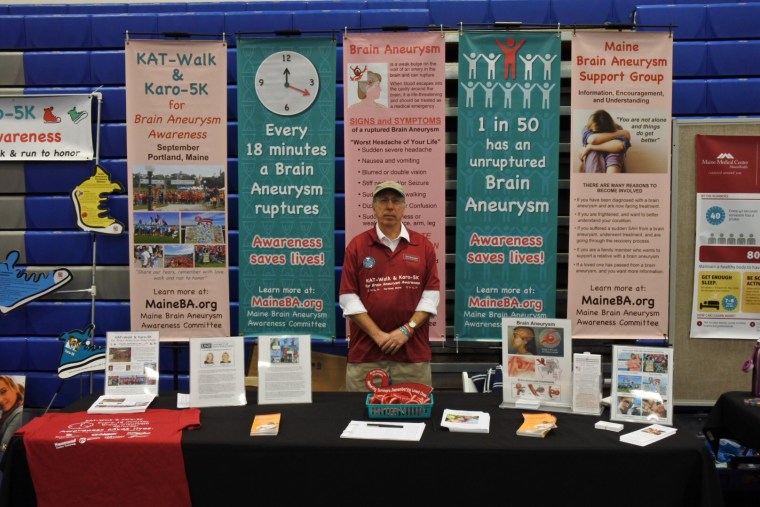
Last Friday evening Dave and I represented the Maine Brain Aneurysm Awareness Committee at the Brain Fair presented by UNE Center for Excellence in the Neurosciences.

This fourth annual event, held at the Harold Alfond Forum at the University of New England in Biddeford, Maine was a wonderful, interactive event for all ages.

Attendees were able to enjoy fun and engaging hands-on activities, presentations, and exhibits. They also found neuroanatomy displays, sheep brain dissections and microscope set-ups where they could observe a variety of microscopic brain pictures. There were also games for the kids and a “Protect The Egg” egg drop creating a fun and educational event for kids and adults alike.

Michael Birman, Ph.D., associate professor of neuroscience and faculty coordinator for the UNE Center for Excellence in the Neurosciences K-12 Outreach Program said it best when he explained, “We want to share with the public how amazing the brain is and how important it is to keep it safe. It’s so critical for every aspect of our life and yet also so fragile.”

Keeping the brain safe was also the highlighted message for the Michael T. Goulet Foundation and their bicycle helmet-fitting and brain injury prevention program. Michael Goulet died at the young age of 21 after suffering a brain injury at 13 and later seizures. His family has devoted their lives to increasing awareness, prevention and improved treatment for seizure disorders and brain injuries. It was wonderful to see so many children picking up new bike helmets and we are proud of our friendship with the Goulet Foundation.

IMG_2720

Many people stopped at our table and wanted to learn about brain aneurysms and several people had relatives who had suffered aneurysms. We were a little unprepared for the children who were there and their questions. While trying not to scare them, we wanted to give them honest answers and still give them something to learn and take away with them. Next time, we’ll come with something a little more fun for the kids.

Dave is much better at starting conversations at these types of events than I am. And I am NOT at my best late Friday afternoon and early evening after a full work week. My conversations had a lot of stops and starts and a lot of fighting to find the right words. Hopefully I made some sense to those in attendance.

As the crowd thinned out, Dave and I were able to wander around together and see the real stars of the show — BRAINS! And I mean REAL brains. They had about 10 human brains to view. Many were healthy brains, but about half of them had some kind of disease or malformation. One even had the full spinal chord attached. It was creepy, but cool.

We were truly fascinated to see the size of a real brain and see the inside of one. Also viewing the Circle of Willis, where the majority of brain aneurysms occur was riveting. My rupture was from that area. Once we told the doctor that was where my annie was, he pointed out that specific area.

One of the brains was from a person who had had a stroke. The damage done to the brain was visibly disturbing but fascinating and a scary indication of what can happen. A large area on the top of the brain was a dark gray color and had collapsed compared to the other side. We were told that person would have suffered disabilities on the other side of the body.

Another brain had a large segment of the dura around it, which is the protective covering of the brain. When a brain aneurysm ruptures, it’s the blood that gets caught between the brain and the dura where damage can occur. The dura is also cut and pulled back to reveal the arteries and brain during a craniotomy, which is what happened to me on my 2nd brain aneurysm. I was intrigued by this brain and the dura. Truly amazing how thin this covering was.

The brains represented here could be held comfortably in both hands. I’m not sure what I was expecting with regards to the size, but I thought it might be bigger. It was the size of the main arteries that really surprised me. The were much larger than I thought. And to think my first brain aneurysm, at almost 1/2″ in diameter, was sticking out of one of those…again…fascinating and scary.

The brain controls EVERYTHING we do. When it’s assaulted by blood and suffers injury, the time needed to recover and rebuild takes longer. It has to…it’s the motherboard for all of our circuits.

Life. Support. Music.

At last month’s brain aneurysm support group, we watched a documentary about a musician from New York City who, against all odds, survived a ruptured AVM. Through the amazing support group around him including family and friends, he was able to not only recover, but prove most of the doctors wrong with their devastating diagnosis’.  Watch a brief follow-up online about the documentary with Jason and his sister HERE.

Tonight, we were able to meet Jason Crigler in person, hear his story first hand, and ask him questions. There truly aren’t enough descriptive adjectives to convey what one feels after hearing and seeing Jason’s story.

In 2005, soon after he returned home from a year-long stay in the hospital, Jason's family (his daughter, wife and father) take him for a walk in the woods.

He is a soft-spoken, warm, and funny man. If you didn’t know his story, one would never know the extent of the struggles he and his young family have had to endure.

Jason’s story was documented by a friend who video taped much of his early recovery and made it into a critically-acclaimed documentary called LIFE. SUPPORT. MUSIC. It’s painful to watch, especially as a survivor of a brain injury myself. He could be me…I could be him. The uphill battles are all very similar, but Jason was very motivate to recover with a new-born baby girl, a budding music career in New York City and a family that sacrificed their own lives and comfort to care for him on an hourly basis.

Tonight was very special and it’s a damn shame more people (even from our own groups) could not attend this widely publicized event. The old adage, you can lead a horse to water but you can’t make him drink, held true tonight I guess. You get what you give…and some people give more than they have to give, but receive very little in return. It’s a damn shame.

Jason’s story is a story that needs to be heard and obsorbed. I only wish I could speak as eloquently and effectively as Jason does, or I’d take my little stent, coil & clip show on the road too. But who the hell would show up to listen to me? Probably only just a few. I know my story isn’t nearly as compelling. We can’t even get an article written about our group.

There was one article written a couple of years ago. About a woman who only came to our meetings maybe two times. She was certainly very attractive & photogenic and lived in an influential area, so that right there was two up on me. Even the one small TV spot we DID have ended up being shared by a completely un-related disease, so we couldn’t even get a full 2-minute spot for ourselves. Really? What DO we have to do????

But…even if we did…would it make any difference? We met a few new people tonight and we welcomed them with open arms as we always do. I hope we see them again and that they spread the word about our group and our efforts to raise brain aneurysm awareness in the state. Exposure could save lives….WE could save lives.

I think you’d be hard pressed to find a group like ours (or at least that one special person) that gives such personal attention to those who have reached out to us. I don’t think the president of many organizations would send personalized emails complete with moving letters and related photos to someone who writes and donates and expressed great regret they’ll be unable to attend this year’s event after having attended all of the other previous ones. I think it’s the personal touch that sets us apart from other groups. The behind-the-scenes workings are amazing and the hard work that goes into every event, every email, every newsletter, and meeting follow up, is more than most are doing. Does it matter?

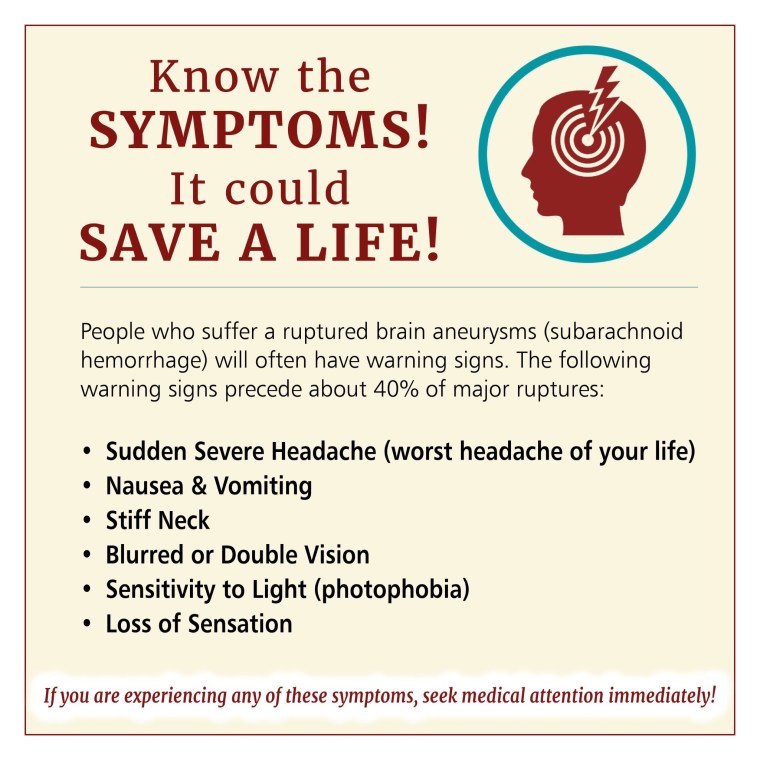
People need to DO more. They are not and it could mean lives of people are being lost as a result. Picking up food for an event will feed the volunteers and participants. For one day out of YOUR life, you could help an event run smoothly and make it a success, meaning those who attended and those who heard about it and read our materials will remember what the event was about and LEARN….and potentially save a life of the next person who has the “worst headache of my life”.

(stepping down off my soap-box now)……back to Jason Crigler.

Jason’s positive & simple attitude about his AVM and recovery is truly inspirational. Many things he spoke about tonight touched me deeply and certainly would have touched a lot more people if they had taken the long hour and a half out of their busy lives.

One thing he said was that there is “strength & power in thought”. We can choose to think we’re failing or think we’re succeeding and it can truly effect the rest of your body. He admits to bad days and depression and despair just like the rest of us, but it’s reminding yourself of the struggles you HAVE overcome and how far you have come that one needs to be reminded of. We all have struggles on a day-to-day basis, but it’s how you deal with, and think about them, that can lead you to a path of strength and power.

I needed to hear those words tonight. My 10-year Annie-versary of my ruptured brain aneurysm is coming up on Oct. 4th. I’m lucky to be here. I know that. I also know others haven’t been so lucky and if sharing my story can save one life, I’m going to do it. If complaining about a lack of support can garner a little bit more, then I’m going to do it.

My sister died from a ruptured brain aneurysm. I had to see her lying in a hospital bed completely unresponsive on a ventilator, with her head shaved, with wires in her open skull and a drain relieving blood from her brain. She was basically gone at that point but we held out hope for a miracle. It never came. I may have failed saving my own sister in educating her enough on the signs and symptoms, but I MAY be able to save one other person. I MAY be able to help one person recognize the symptoms and get them to a hospital in time.

I have to hold on to that…otherwise, why was I saved and Dori wasn’t and why was I saved and Dave’s beautiful 32-year old niece Kim wasn’t? Two beautiful, sweet, funny souls who did nothing but good for others. I’m not nearly as beautiful or sweet, so I have funny going for me…and a chance to DO something in this world and get the word out and share my story.

I may not have friends who care enough about me to film a  documentary, come to our events and support me, tour the country and make money from it, but I DO know I am blessed to be here still.

THANK YOU Jason, for sharing your story, answering our questions, and driving all the way up to Portland to meet with us. And thank you for making people aware of the struggles people with brain injuries can endure…and more importantly, can overcome. You’re a true inspiration!