So Many Stories

Kim and Dori
Kim and Dori will be honored on the car.

It has been five years since my sister Dori died from a ruptured brain aneurysm. She was the same age I am now. She left behind a 15-year old son. She didn’t live to see her son turn 16 later that same year and wish him a happy birthday. She didn’t live to see him graduate from high school and give him a hug and tell him how proud she was of him.

Dori’s story is just one of the many brain aneurysm-related stories  my husband and I tell when we meet other people. We have met so many over the last 11 years.  So many wonderful, uplifting survival stories, but also too many heart-breaking reminders of  the devastating, life-changing effects a brain aneurysm can have on a family.

I survived my first brain aneurysm rupture in 2006, but just two years later Dave’s niece Kim died suddenly of a rupture at the young age of 32. Heart-breaking, soul-shattering and devastating our small family to the core.

Each year we meet more individuals, more relatives, more survivors, and more medical people with brain aneurysms being the common thread that binds us.

Dave and I didn’t ask for this cause. No one does. If found us.  After Kim died, we could have easily turned away and ignored the reason behind her death and behind my near-death experience. I could have walked out of the hospital after 20 days and 6-months of recovery and never wanted anything to do with brain aneurysms again. Some do. They think once the doctor “fixes” them, they’re all set to go on with life and never look back.

However, to ignore the issues that brought us to that life-threatening event, or to ignore the sudden death of a loved one or friend, is to give this disease the upper hand and potentially kill & disable people.

Yes, we started the KAT-Walk in 2009 to honor Dave’s niece, but we also want to educate the public to the symptoms and treatments available for brain aneurysms.  Our event, and other events throughout the year, have become bigger than just a local walk to honor a beautiful, vibrant young woman.

It’s the STORIES that continue to steer this wee boat in the storm.

It’s the STORIES that show us the incredible strength one person can have despite overwhelming odds and despair..

It’s the STORIES that tear out your heart and remind you just how precious life is.

It’s the FACT that by sharing our STORIES, we can actually save a life if we’re able to educate someone to get to the hospital and fight for your own health and the life you share with your family.

All of those stories are IN me now. I KNOW those stories. I KNOW those people. I have my own heartache and my own medical struggles I am still dealing with, but so does everyone else. I’m not special in that regards and I’m not famous by any means, but I CAN do something and I CAN help lend comfort, share knowledge, and yes, save a damn life.

So, this Saturday, when I walk to honor the lives of Kim and my sister Dori, I’ll also walk to celebrate my survival and all of the STORIES we have been told the last 11 years. I feel the stories of everyone I’ve been in contact with. We need to help people understand what a brain aneurysm is. We need to share our brain aneurysm stories.

I hope you’ll join us. Visit MaineBA.org for more event information.

Brain Aneurysm Awareness

Always There

At tonight’s brain aneurym support group meeting, I was reminded of the potential peril I may still be in.

My neurosurgeon/interventional radiologist gave a presentation about new treatments of cervix carotid artery brain aneurysms — aneurysms on the carotid artery in the neck. This was very relevant to one survivor in our group who has a 2nd aneurysm that is being watched right now in that sam area.

This report was originally given to neuro-medical doctors and was quite detailed with highly-medical terminology.  As explicit as it was, one was able to get the gist of it: they’re doing some pretty amazing things these days and saving lives.

The report was also funded by a research grant sponsored by our Maine Brain Aneurysm Awareness Committe, and Dr. Ecker explained how the money we gave was being used to purchase the detailed imagery needed for this paper. We are thrilled to be able to do it.

This presentation was about 30 minutes interspersed with questions from our group and Dr. Ecker giving us great explanations. Then a second, 10-15 minute presentation was given regarding his use of the pipeline procedure which is saving many, many lives and used more and more. I only wish it could be used with my case.

It was humbling of Dr. Ecker to admit that there are some aneurysms that are just trouble makers and that they can only do so much in some cases. Meaning, they’re still only human and one of their biggest challenges is the interaction between metallic fixtures and human biology with in the brain.

Some people just have such funky arteries due to vascular disease that the doctors can try and try to do everything they feel is right but due to the physical makeup of their arteries, it’s a challenge. I’m pretty sure I’m one of those challenges with my larger1st aneurysm.

Dr. Kwan, my doctor at the time in 2006, did the best he could at that time to fix my 1/2″ diameter brain aneurysm and save my life.  It worked…for five years until the 16 platinum coils inserted into the aneurysm started to compact and blood started to get back into the aneurysm.

Enter Dr. Ecker and the stent and four additional coils he added to my metal repertoire. This procedure went very well and everything looked great. Until more blood started getting into the neck of the aneurysm again and we are now watching it.

Because I already have a stent in that artery directing blood flow past the neck of the aneurysm, it’s highly unlikely and not recommended that using the pipeline will, or CAN be used to keep blood from getting back into the aneurysm.  And the research and reported procedures on putting a stent inside of another stent with similar conditions is non-existent. Hence…more waiting.

In the meantime, I live my life one day at the time hoping more blood isn’t getting into the neck and forming a bulge there that may, or may not rupture. I don’t have high blood pressure, I have never smoked, but I do have a highly stressful job for about 3-4 months of the year and I am not eating that great or exercising. From what I see, even if you ARE in great shape…if your arteries are “funky”, they’ll do what the want to – aneurysms really don’t discriminate.

Dr. Ecker and I have previously discussed options and they’re quite limited at the moment, but seeing the groundbreaking procedures that are being done in our very own state is giving me hope that a solution is in sight. I’d prefer NOT to be one of those challenges, but my arteries have other ideas.

I don’t think about it everyday, but certainly after a session like this, it’s the topmost thing on my mind and knowing there are doctors and a great staff here in the state of Maine is a comfort. I KNOW they’ll do their best and I KNOW they’ll give me the best advice and recommendations at their disposal. We are blessed to have such talented doctors in our state who are taking such good care of us. THANK YOU!


Brains R’ Us

Last Friday evening Dave and I represented the Maine Brain Aneurysm Awareness Committee at the Brain Fair presented by UNE Center for Excellence in the Neurosciences.

This fourth annual event, held at the Harold Alfond Forum at the University of New England in Biddeford, Maine was a wonderful, interactive event for all ages.

Attendees were able to enjoy fun and engaging hands-on activities, presentations, and exhibits. They also found neuroanatomy displays, sheep brain dissections and microscope set-ups where they could observe a variety of microscopic brain pictures. There were also games for the kids and a “Protect The Egg” egg drop creating a fun and educational event for kids and adults alike.

Michael Birman, Ph.D., associate professor of neuroscience and faculty coordinator for the UNE Center for Excellence in the Neurosciences K-12 Outreach Program said it best when he explained, “We want to share with the public how amazing the brain is and how important it is to keep it safe. It’s so critical for every aspect of our life and yet also so fragile.”

Keeping the brain safe was also the highlighted message for the Michael T. Goulet Foundation and their bicycle helmet-fitting and brain injury prevention program. Michael Goulet died at the young age of 21 after suffering a brain injury at 13 and later seizures. His family has devoted their lives to increasing awareness, prevention and improved treatment for seizure disorders and brain injuries. It was wonderful to see so many children picking up new bike helmets and we are proud of our friendship with the Goulet Foundation.

IMG_2720

Many people stopped at our table and wanted to learn about brain aneurysms and several people had relatives who had suffered aneurysms. We were a little unprepared for the children who were there and their questions. While trying not to scare them, we wanted to give them honest answers and still give them something to learn and take away with them. Next time, we’ll come with something a little more fun for the kids.

Dave is much better at starting conversations at these types of events than I am. And I am NOT at my best late Friday afternoon and early evening after a full work week. My conversations had a lot of stops and starts and a lot of fighting to find the right words. Hopefully I made some sense to those in attendance.

As the crowd thinned out, Dave and I were able to wander around together and see the real stars of the show — BRAINS! And I mean REAL brains. They had about 10 human brains to view. Many were healthy brains, but about half of them had some kind of disease or malformation. One even had the full spinal chord attached. It was creepy, but cool.

We were truly fascinated to see the size of a real brain and see the inside of one. Also viewing the Circle of Willis, where the majority of brain aneurysms occur was riveting. My rupture was from that area. Once we told the doctor that was where my annie was, he pointed out that specific area.

One of the brains was from a person who had had a stroke. The damage done to the brain was visibly disturbing but fascinating and a scary indication of what can happen. A large area on the top of the brain was a dark gray color and had collapsed compared to the other side. We were told that person would have suffered disabilities on the other side of the body.

Another brain had a large segment of the dura around it, which is the protective covering of the brain. When a brain aneurysm ruptures, it’s the blood that gets caught between the brain and the dura where damage can occur. The dura is also cut and pulled back to reveal the arteries and brain during a craniotomy, which is what happened to me on my 2nd brain aneurysm. I was intrigued by this brain and the dura. Truly amazing how thin this covering was.

The brains represented here could be held comfortably in both hands. I’m not sure what I was expecting with regards to the size, but I thought it might be bigger. It was the size of the main arteries that really surprised me. The were much larger than I thought. And to think my first brain aneurysm, at almost 1/2″ in diameter, was sticking out of one of those…again…fascinating and scary.

The brain controls EVERYTHING we do. When it’s assaulted by blood and suffers injury, the time needed to recover and rebuild takes longer. It has to…it’s the motherboard for all of our circuits.

Happy 10th Annie-versary to Me!

Brain Aneurysm Survivor
My story in bullet points.

10 years ago today, my life changed when an 11mm (almost 1/2″ in size) brain aneurysm ruptured around 4:30 in the morning. Happy 10th Annie-versary to Me! That’s what brain aneurysm survivors call the anniversary of the day they found out they had a brain aneurysm, the day they had their surgery, or the day it ruptured. Each year a survivor is alive is a celebration and one that should be marked in some fashion. After losing my sister and my husband’s niece to sudden ruptured, and undetected brain aneurysms, I know all too well the horrific, and sudden toll this silent killer can take on families.

Last week I was lucky enough to take part in a brain aneurysm survivor’s breakfast in New York City leading up to the Cerebral Affair Gala that same night. Both events were hosted by two of the biggest players in the brain aneurysm awareness community: The Lisa Colagrossi Foundation and The Joe Niekro Foundation. As with our support group in Portland each month, the stories survivors tell are remarkable, heartbreaking, and inspiring all at the same time. Everyone’s story is different. Everyone’s brain aneurysm is different. And everyone’s struggle is different. However, we all share the same fears and anxiety that come with surviving. Why did I survive when countless other’s did not? Is the headache I have right now a symptom of another rupture? If I had one aneurysm, is it a certainty I’ll get another one?

Fellow Survivors & their Family Members
Some of the survivors & their family members who attended the survivors round-table and breakfast.

The survivor’s breakfast was a profound reminder of just how important it is that survivors tell their stories again and again to everyone and anyone who will listen. You never now when YOUR story will resonate with one person and one life could be saved.

I HAD heard the terms “brain aneurysm” prior to my rupture in 2006, but I had no idea it could be hereditary in some cases and I had no idea the damage it could do. I vaguely remember the ER doctor coming in and asking me if anyone in my family has a brain aneurysm. I THINK I may have said “yes” because my cousin Debbie had just gone through coiling a few years prior and I know my cousin Tim had suffered a rupture.

When the doctor said I had a ruptured brain aneurysm that was bleeding, I remember thinking “Well, that can’t be good.” I’m one of the lucky ones to even have any knowledge and memory of those events and discussions. For many, the damage with the initial rupture is too great to overcome. I am still able to work the job I left for six months to recover back in 2006. I am still able to drive. Many are not.

My deficits are embarrassingly minor compared to others. Fatigue lasted a LONG time. Maybe years. I was lucky enough to NOT have major headaches for long periods of time after my rupture but bending over at certain angles still causes discomfort. I can’t say it’s pain, but it isn’t pleasant. And coughing still causes discomfort and my brain can get easily over stimulated with visual or vocal clutter.

Because my rupture was coiled, I didn’t have any outward indication of surviving a brain injury unlike the craniotomy I endured in 2014 for a second un-ruptured brain aneurysm. I think that’s why people can assume you’re fine. Outwardly, you DO look fine, but inwardly, we are suffering and struggling and only another survivor can understand that.

The 2nd brain aneurysm I had was clipped and after my last angiogram, it appears to have completely gone away. The first one that ruptured 10 years ago this morning, is STILL giving me issues. The 16 platinum coils inserted into it started to compact after five years, then four more coils were added and a stent was inserted to allow the blood to flow PAST the aneurysm instead of into it. However, there is still a little remnant of blood between the neck and the stent. It’s the annie that won’t go away.

This is my BrainSome days I still struggle with the not knowing. I truly hate the “watch and wait” option. Been there, still doing that. But this bugger is not an “easy fix” at this point. If it starts to enlarge or change shape, more coils could be in order. Sure, why not! Let’s load me up with more metal. 20 coils, a stent, and a clip. My Brain Bling!

As I was reminded during the survivor’s breakfast last week in NYC, I need to remember how blessed I am and that I should continue to be grateful. I AM grateful and I know I am blessed, but I have also been devastated by brain aneurysms in losing my sister, leaving a 15-year old son behind. I’m devastated by Dave’s niece Kim dying at the far-too young age of 32 and being found by her mother. No one should have to endure that and it broke my heart.

If my long, often soap-boxy blog can help just one person and educate anyone about brain aneurysms, then I am doing something right. I am doing something positive and I am doing SOMETHING to help shed light on the deadly consequences of ignoring symptoms that could kill you or a loved one.

I suppose God left ME here to be one of the voices for those who aren’t with us anymore. It is my honor to do so.

Me! Brain Aneurysm Survivor

Thank you to all of those people who supported me during that time I was in the hospital 10 years ago and the following months of initial recovery. I couldn’t have done any of it without my Maine man, however. He’s my rock, my chauffeur, my nurse, my sounding board, and my love. I am blessed to have had him in my life 10 years ago to help save me.

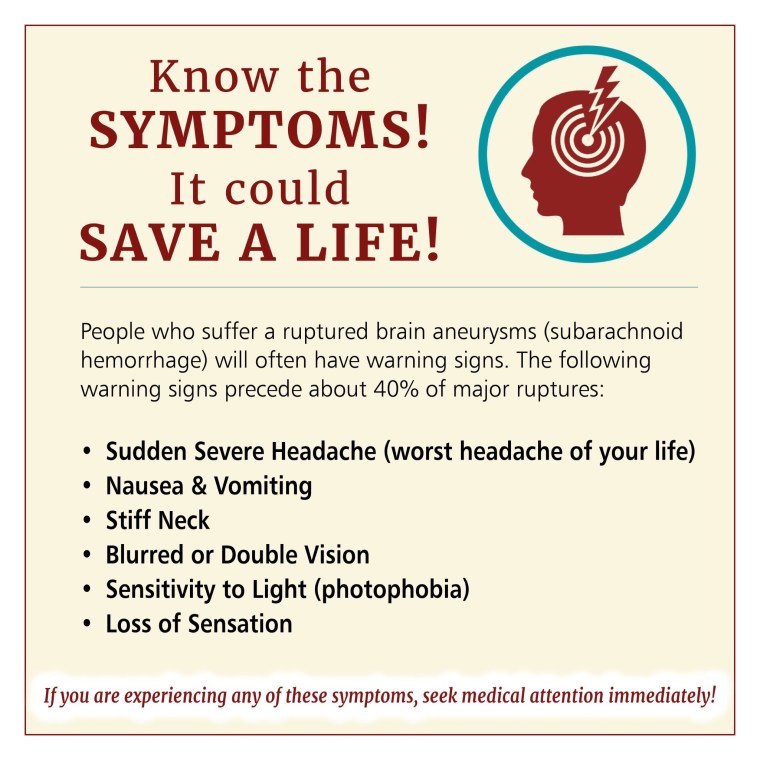
Learn about brain aneurysms and spread the word! Symptoms of a Brain Aneurysm