October, Shocktober

October has always been a bitter-sweet month for me and my family.

The Sweet:

  • my nephew Ian was born (he’s now a handsome 19-year old!)
  • my step-nephew Adam was born
  • my sister Dori was born

The Bitter:

  • my Dad was diagnosed with cancer in October (lost him in 1994 – 6-months after diagnosis)
  • my Mom passed away in October last year (2014)
  • my brother-in-law Fred was killed in October
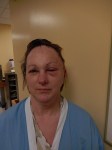
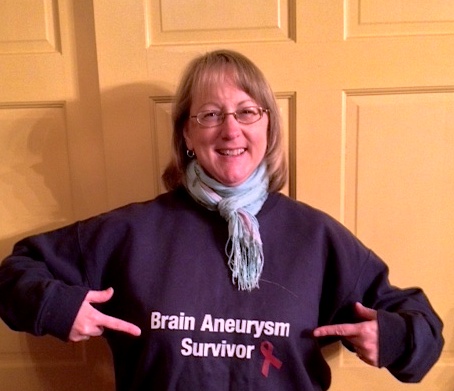
  • I suffered a ruptured brain aneurysm in October in 2006.

And I’m sure I’m leaving something out, but those are the biggies. I think that’s enough, don’t you?

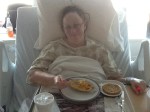
October 25th is a bitter-sweet day for me as well. It was Dori’s birthday, but it was also the day I was released from the hospital after a three week stay nine years ago next week. I remember speaking to Dori on the phone after I got home and she told me my coming home was the best birthday present I could have given her. We were both crying.

How awful that six year’s later, I was crying in a London hotel room after findiing out Dori had suffered a ruptured brain aneurysm too and I never got a chance to say good-bye and let her know how much I loved, and adored her.

Brain aneurysms simply suck. They take the lives of young, old, healthy, joyful people, and devestate the lives of those they love. Granted, they don’t always kill, but they certainly can cause distruption and change the lives of all those around you forever.

October is also a stressful month for me at work. With my rupture happening in the critical last weeks of catalog production, it was left to our small crew and a poor graphic artist brought in to pick up the pieces to finish the book. They did the best they could. Three months later I returned to work part-time to find my office with calendar’s still set on October and reminders on my computer for jobs that needed to be completed…in October. A surreal experience for sure.

I am one of the lucky ones who #1, worked at a great company that allowed me the time to heal and recover and #2, I was physically able to perform my job full time after a 6-month recovery period. Soooo many are not so fortunate and the needs of survivors and their issues after a rupture are so varied, it’s difficult for employers and co-workers to truly understand the depth of recovery needed.

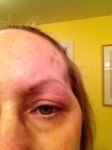
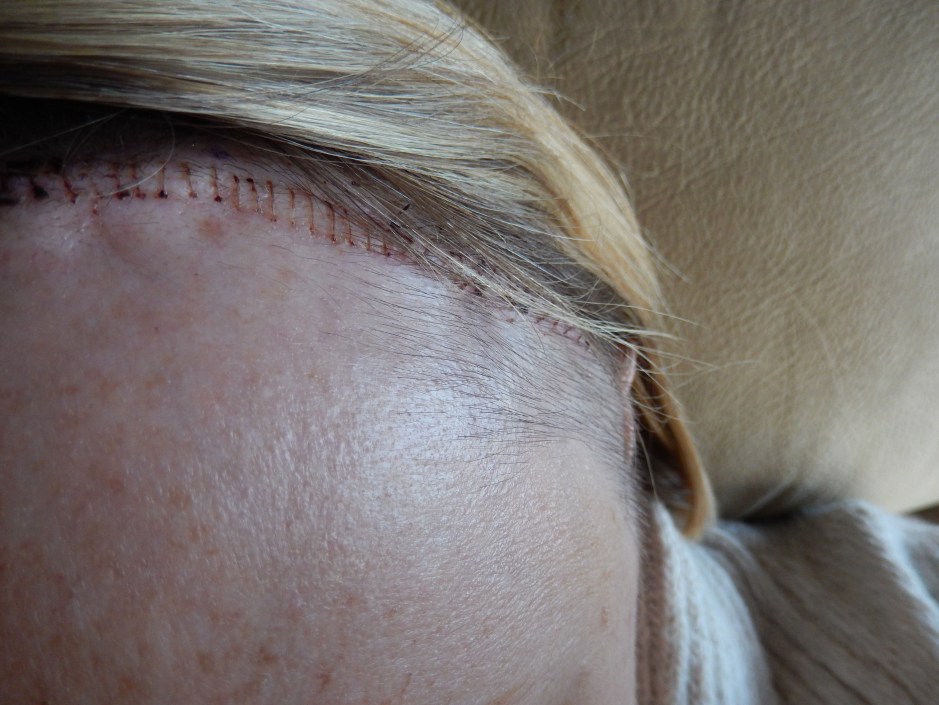
I suppose that’s one of the reasons I speak out about brian aneurysms and try to educate others. Although this blog as been theraputic for me personally, I have received a few comments from other survivors and those who have lost loved ones who tell me it has helped. That means more to me than any amount of money I could raise. Support is what we all need. I have survived a rupture, a coiling, a re-coiling and a stent, then a craniotomy on a 2nd un-ruptured brain aneurysm. And that first large brain aneurysm is STILL giving me issues. Look for updates on more potential “brain bling” in the New Year!

Every October I remember the day of my rupture. Every October I remember my mother’s death now. I remember my father’s diagnosis with cancer and I remember my sister’s birthday on October 25th. I still hate October, but I’m here. For whatever reason, I. AM. HERE.


A Compelling Story

You need to have a compelling story. That’s what we’ve been told our group (Maine Brain Aneurysm Awareness) needs in order to get some local television coverage. Webster’s dictionary’s definition of the word “compelling” is:

: very interesting
: able to capture and hold your attention
: capable of causing someone to believe or agree
: strong and forceful
: causing you to feel that you must do something

So, apparently no one feels the following examples are compelling enough to warrant at least one television or newspaper interview in the last 6 years?

  • A vivacious 32-year old died suddenly in her bathroom of a massive ruptured brain aneurysm three days after Christmas. She lived alone and was found the following morning by her devastated mother. (The KAT-Walk was created in her memory & honor)
  • The husband of a ruptured brain aneurysm survivor also lost his niece and sister-in-law to ruptured brain aneurysms.
  • A woman from New Hampshire was vacationing in Maine and suffered a ruptured brain aneurysm in Shaw’s Supermarket. After a misdiagnosis, she eventually went to Maine Medical Center where the only interventional radiologist in the state saved her life. A few years later, she also survived breast cancer and a double mastectomy.
  • A man suffered a ruptured brain aneurysm while home alone. After many hours, his young children discovered him after coming home from school. Two hospitals and a trip to Boston saved his life.
  • A 40-year ruptured brain aneurysm survivor had to be taken to Canada.  At the time of her rupture, no one in the northeast did brain surgery for aneurysms then. The original clipping failed and she was re-clipped. Which means multiple craniotomies. She is a walking miracle.
  • A much-loved 53-year old woman died of a massive ruptured brain aneurysm on Mother’s Day after presenting symptoms two previous visits to doctors, leaving a husband and a 15-year old son behind.
  • A beautiful 28-year young woman, who was an active runner and very physically fit, suffered a ruptured brain aneurysm while working out. She never recovered leaving her family devastated. She was to be married only a few short weeks after her death. (The Karo-5K was created in her memory & honor)
  • One woman survived a ruptured brain aneurysm that was filled with 11 coils, only to lose her sister to a ruptured brain aneurysm six years later. Then Dr’s discovered she also had a second brain aneurysm which was clipped via a craniotomy, but the original one that ruptured is still giving her cause for concern 9 years later.
  • A father of three survived a devastating ruptured brain aneurysm. The deficits he and his family have faced are life-altering and difficult but he IS alive and living life to the fullest.
  • A woman’s ruptured brain aneurysm at 4 a.m. left her with limbs numb, speech slurred, a rapid heart rate, sweating, and falling to her knees. The EMT’s who arrived at her home took her blood pressure and asked some questions. They determined it wasn’t a serious issue and left it to the patient if she wanted to go to the hospital or not. Thankfully she went on her own and the Dr. in the ER sensed what it could be and had her scanned and transported to Maine Med where her life was saved.
  • A young, talented, 13-year old boy fell victim to a ruptured brain aneurysm in his home. The outpouring of grief and support after his death was overwhelming. (Nolan’s H.E.R.O. Foundation)

I could go on and on if I knew I could accurately describe the situations of everyone that I have met. So many stories of hope, fear, disaster, strength, and courage.

So…apparently none of those stories are compelling? How many people have to die and suffer debilitating deficits before this cause it compelling enough to the local news media? To those whose lives have been touched by brain aneurysms there is plenty to hold one’s attention. Survivors HAVE to begin to believe they’ll be fine or they’ll crumble. And in many cases of those left behind, the desire to DO something is overwhelming after these silent killers attack without warning in some cases. Our fundraising events do more than raise money to help other families, they raise the hope and spirits of those left behind or those surviving.

We were lucky enough to have a lovely article written about Kim after her passing. It was written in the local sports section because she was a fantastic softball player, but beyond that, we have received little to no local media support focused solely on our cause. It’s not for our group’s benefit…it is to raise awareness and to allow others who have been touched by brain aneurysms to gather and support one another.

Our cause doesn’t have a specific color that we brand; doesn’t have a celebrity spokesperson that everyone adores; or a social media “challenge”. The more we’re able to talk about brain aneurysms, the more awareness will be raised and hopefully we can SAVE A LIFE.

I think that’s pretty “compelling” don’t you?

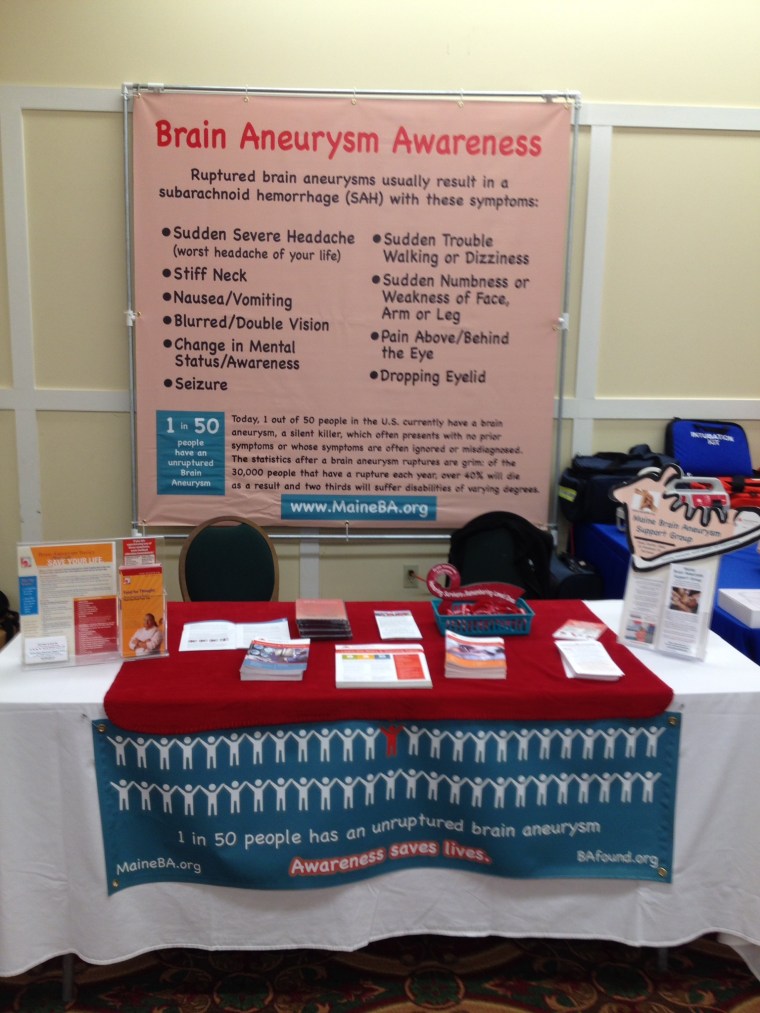
READ MORE About Us: MaineBA.org

It is estimated that up to 1 in 50 people in the U.S. will develop a brain aneurysm during their lifetime. Each year about 30,000 people will suffer a ruptured brain aneurysm. Almost half of the victims will die and of those surviving, only one third will recover without disabilities.

Kick The Can

Well, after meeting with my neurosurgeon this morning we have decided to kick the can for another year on the blood remnant in my large brain aneurysm. Yes, it’s there, but it doesn’t pose any immediate risk at the moment – they think.

Options currently presented are:

  1. Do nothing and observe with periodic angiograms/MRA’s.
  2. Insert more coils (I have 20 already) into the aneurysm in hopes no more blood gets in.
  3. Block off the affected artery and see if the blood flow reverses.
  4. Place the relatively new Pipeline™ Embolization Device INSIDE the existing stent that was place in the artery in 2011.

Here is how we’re addressing each option:

Watch & Wait: Simply monitor the remnant with periodic angiograms and/or MRA’s. Then if it appears it IS growing and more blood is getting back into the aneurysm, THEN we act. It could do nothing for 10 years, or it could double in size by next year.

More Coils: I already have 20 coils and a stent that is supposed to be blocking blood getting into the brain aneurysm. Obviously, they’re not doing their job as hoped and expected.

Sacrifice the artery where the aneurysm is & reverse blood flow: This procedure will require doing a balloon occlusion test first to determine if my vascular system can handle the blood flow being shut off. IF the balloon test is successful, then I would be a candidate for having that “diseased” part of my artery completely filled with coils and the blood flow would reverse. I’m still trying to understand how it all works.

The Pipeline inserted inside existing stent: The doctor had done some research and this specific procedure has only been done ONCE, at least in the U.S. that he is aware of. Not exactly a glowing recommendation. Even one of the most renowned neurosurgeon’s in the country has shied away from doing it.

It’s pretty safe to say we have ruled out options 2 and 4. Adding more coils doesn’t seem like a more durable option at this point and even though the Pipeline has been used VERY successfully throughout the entire country, including here in Maine by my doctor, the lack of data and positive feedback on inserting one into an existing stent doesn’t bode well for its use in my specific situation. I’d rather not be a test subject unless all other options have been exhausted.

So, we’re going to do a combo of 1 and 3. Well…at least #1 at this point.

Blood Supply To The Brain

I’ll have an angiogram next Spring AND have the balloon occlusion test done at the same time. There are four main arteries supplying blood to your brain. In most people, there are links between these four arteries that allow for one of the arteries to be blocked without significantly affecting the amount of blood reaching the brain. The balloon occlusion test is usually done if there is an abnormality (in my case, an aneurysm) in one of the four main arteries. It is a way to see whether one artery can be temporarily or permanently blocked without significantly affecting the level of blood in your brain. An X-ray and a special dye are used to create images of your arteries and a small balloon, which when inflated will temporarily block your artery. Sounds scary, but if you’re on the table in the hospital already, they simply deflate the balloon if you’re unable to handle it.

The angiogram will allow us to see if the remnant has grown in a year and we’ll have the balloon test done and that will determine, should I NEED to treat the remnant, that blocking the artery and reversing the blood flow is a good option. If I’m unable to handle the test, then that’s another option off the table.

There is another potential, more invasive option, but I’m not even going to go there yet. We’ll wait a year, see if the remnant has gotten any bigger, and DOES need treatment, before we address it further.

So, I’ll continue to eat better, try to get more exercise, and reduce stress……the last one will be the hardest I think. Kick the can….


Reminders

Our monthly brain aneurysm support group meetings are a wonderful way for survivors, their supporters and for those who have lost loved ones to come together and discuss this horrible thing that connects them. The fantastic medical professionals who have come to speak with us have opened the eyes of those who haven’t been educated themselves and have helped supporters gain a better understanding of what their loved one has gone through. I rarely come away from the meetings feeling anything other than positive energy and proud of the group, but tonight was different.

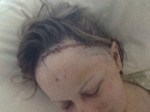
Dori and I in Maine Three years ago tomorrow, we had to say goodbye to my sister Dori. Her rupture was massive and deadly. She ruptured on Mother’s Day and was kept on life support until the 29th of May. No signs of life and no signs of recovery were recorded. They had shaved her long, thick, mostly gray hair from her head completely. She was on life support, a ventilator, and had a drain set up to alleviate and remove fluid on her brain. It’s an image that still haunts me as the last time I saw her.

Some of our discussions this evening at the support group centered on drains and locations of brain aneurysms. Dori’s aneurysm ruptured on her brain stem, which was catostrophic. As these discussions took place tonight with a survivor who had a drain and a rupture, the image of Dori in that hospital bed was running on a loop in my head. I’m glad we flew back from London immediately to see her at the time, but it technically wasn’t her in that bed. She really was gone the day of the rupture but I see her in that bed this week and my heart hurts because I miss her so very much.

I know for those who have lost a loved one, the support group can be sad, educational and scary all at the same time. Usually I’m naturally focused on the survivor side of it because I am one, but unfortunately, I also have the flip side as part of my life in losing my sister and Dave’s niece to massive ruptures. The successes (me surviving I guess) don’t quite balance out the failures (losing Dori and Kim) but life still goes on around us and I’m still alive to try and help others if I can. If we’re able to get one person scanned or help one survivor understand their situation better and offer comfort, then those lives lost will always be with us as a reminder at how precious life is and how we all can DO something.