Happy Puzzle Day!

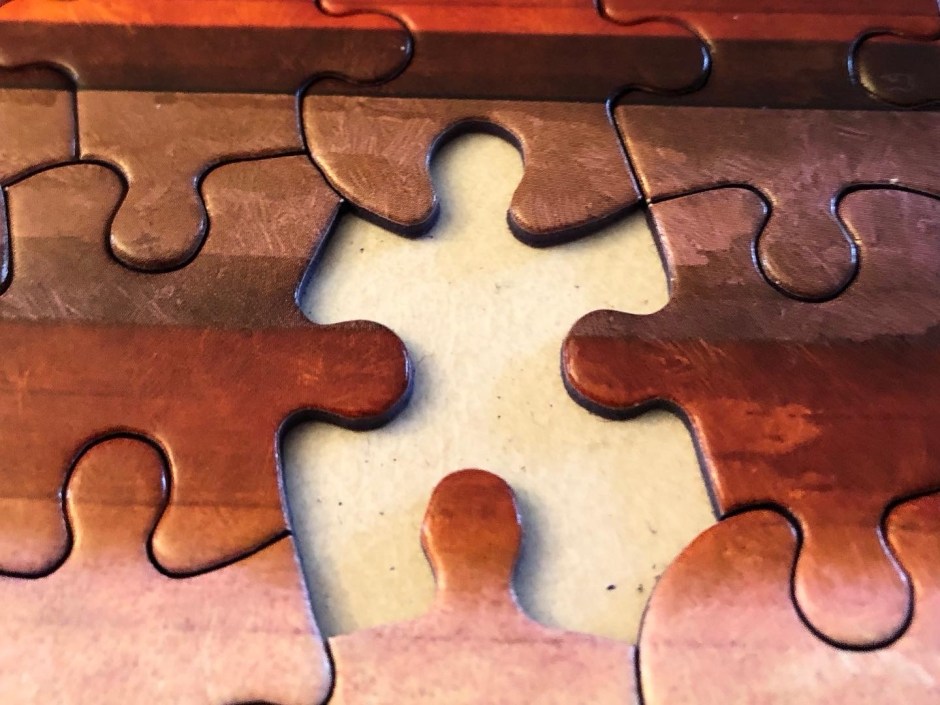
Happy National Puzzle Day! I can’t recall doing many jigsaw puzzles growing up. My first recollection of puzzles filling a need, was during the time my dad was fighting cancer. 

The hospital in Buffalo, NY where he was treated for five months, had a large waiting room where my mother and two sisters would gather until the next time we could see him. There was always a puzzle set out on the table. I found it a wonderful way to pass time, settle my mind on something other than the trauma our family was going through, and a small reward each time you found the right piece for the right spot. 

I picked up puzzles again, a few years ago after having a difficult couple of months where we had to say goodbye to our two beloved senior kitties within months of each other. I reconnected to the calming and challenging influence finishing a puzzle had.

As a brain aneurysm survivor, I also take comfort in knowing my brain is being exercised while working on puzzles.

According to many reputable online sources, working on jigsaw puzzles can help keep your brain healthy by improving memory, problem-solving skills, and cognitive function. Engaging in puzzles activates different parts of the brain, which can enhance overall mental sharpness.

Cognitive Improvement

  • Memory Enhancement: Jigsaw puzzles help improve short-term memory by reinforcing connections between brain cells.
  • Visual and Spatial Reasoning: They enhance the ability to visualize and manipulate objects in your mind, which is useful for tasks like reading maps or driving.
  • Problem-Solving Skills: Regularly solving puzzles encourages creative and effective problem-solving through trial and error.

Mental Health Benefits

  • Stress Relief: Engaging in puzzles can reduce stress levels, similar to meditation, by allowing the brain to focus on a single task.
  • Mood Enhancement: Completing puzzles increases dopamine production, which improves mood and concentration.

Overall Brain Health

  • Cognitive Delay: Regular participation in puzzles may delay the onset of dementia symptoms by up to two and a half years, although they cannot prevent dementia on their own.

Not all puzzles are alike, however. Some have thinner pieces, some have pieces that are the exact same size and shape, and others are frameless. I prefer ones with a straight edge frame, slightly larger pieces that aren’t too thin and that are cut in different shapes. I was gifted a hand-made puzzle and could not finish it. Not only was it printed on a glossy surface, which made seeing the pieces difficult, but they were all the exact same size and shape and very thin, which made it easy to misplace or slip out of my fingers. I ended up abandoning it because, although it was a huge challenge, it wasn’t fun or relaxing in ANY way.

My favorite puzzles are from White Mountain Puzzles in Vermont. I like to do 1,000-piece puzzles that are beautiful scenes or subjects that interest me like the ocean, cats, birds, or tea. The large, portable puzzle table I purchased also provides a safe place to house the puzzle and its pieces from our new kitties we adopted.

There is a true sense of accomplishment when I finally place that final piece.

The Big Picture

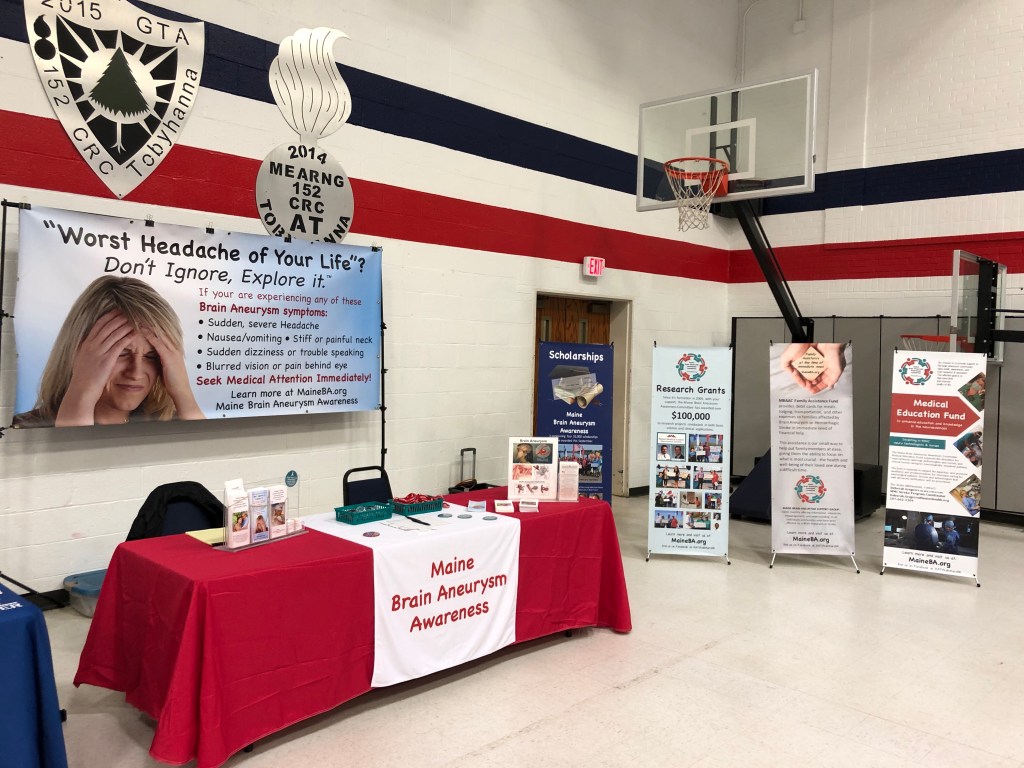
Yesterday, Dave and I spent the afternoon at the Brain Injury Resource Fair in Augusta, Maine. This annual event, sponsored by the Brain Injury Association of America – Maine chapter, was the first held since the pandemic. Our brain aneurysm group had a table along with many, many vendors from different areas of Maine and New England.

The program director of the Maine chapter of the BIAA is headed by Sarah Gaffney who is a spark plug of encouragement and energy. As usual, she and her team did an amazing job with this event. Sarah’s advocacy is motivating and impressive. I was honored when she asked me to tell my story in their November 2020 newsletter.

Dave and I had to shake off some of the cobwebs while setting up our many banners and table-top displays as it has been so long since we have attended any indoor events like this. It felt good!

We might be a small group, but our presence was mighty! 🙂

It was wonderful to see so many familiar faces in person and reconnect with some of the many, many people whose daily focus is to assist the brain injury community here in Maine.

These events are always a challenge for me, mainly because I’m better with faces, but horrible with names. Dave, on the other hand, has a great memory and all of his faculties when it comes to matching names to faces. I didn’t see much of him during the 3-hour event because he was busy catching up and networking with other vendors around the large arena at the armory. This is one of THE best events in the state for doing that.

We got reacquainted with our table displays again.

As the general public started to arrive, you’re quickly reminded why we were all there: to offer much needed education, outreach, information, and resources to those who desperately need it.

I do relatively well when people ask questions regarding brain aneurysms, but when a question is thrown my way that I wasn’t expecting and haven’t had to answer before, I can often struggle. I feel bad I may not give the answer the person was looking for, but I try my best. Dave is much better at that than I am. When I get tired, I can also start to fumble with my words. But I think I’m among friends here who are more forgiving.

Every type of brain injury is represented at this event and every type of service can be found, but knowing where to look is one of the biggest problems, especially in such a rural state like Maine.

Since the pandemic, our brain aneurysm support group has only been held virtually, via ZOOM. So it was wonderful to meet two newer members of our support group in person today for the first time as well as meeting one of our previous speakers in person. I’m very proud of our small group. I KNOW we’re doing good work and today only validated that. If we can help one person feel better, find resources, or navigate a challenge, it’s all worth it.

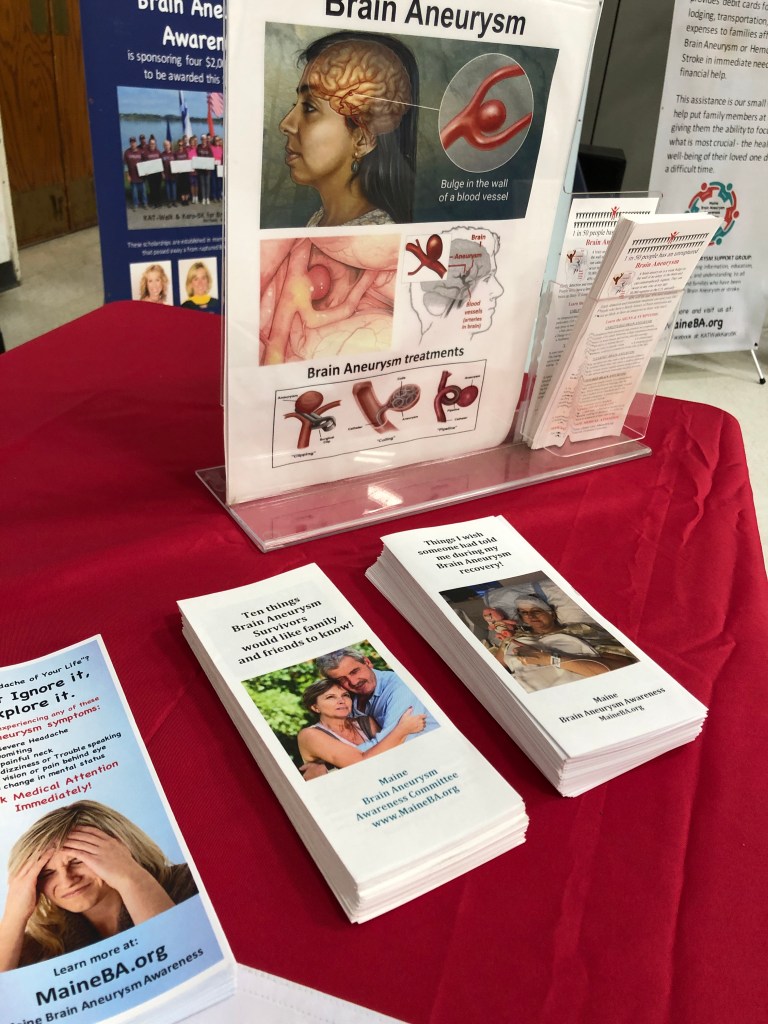
The general public and other vendors appreciated the brochures.

The term “brain injury” encompasses a wide range of issues from mild concussions to debilitating damage from severe trauma, stroke or tumors. The struggles survivors endure can be very similar, but every story, every injury is different and requires different needs. Witnessing the strength and daily commitment of survivors and their caregivings is an inspiration. It’s not easy. It’s frustrating, scary, and complex. Knowing where to go for support and care can improve the daily lives of not only the person who is struggling, but for their families. Events like todays are so important and we were thrilled to be a part of it.

I created this short reel some time ago to highlight some of those struggles survivors deal with.

See You in Three Years

I first met Dr. Ecker on December 3rd, 2010. In all that time and the different medical procedures we have been through, I don’t believe I have ever hugged him. Yesterday I broke that patient/doctor barrier and gave him a very warm, tight embrace.

Twelve years ago, he picked up my aneurysm story where Dr. Kwan left off four years prior. Aneurysm #1 ruptured in 2006 and is the problem child. Even after 16 initial coils, blood was getting back into the aneurysm. Dr. Ecker has been trying to improve the situation and produce favorable results with several attempts. Two stents and 4 more coils later, we might be at a turning point in our professional relationship with this pesky bugger.

As noted in my previous post, I was thrilled and emotional to hear how well the flow-diverting stent deployed back in April was doing. I certainly was relieved, but until I saw the images and spoke to him in his office after he had a chance to review everything again, I still wasn’t celebrating to the point of calling it “done”.

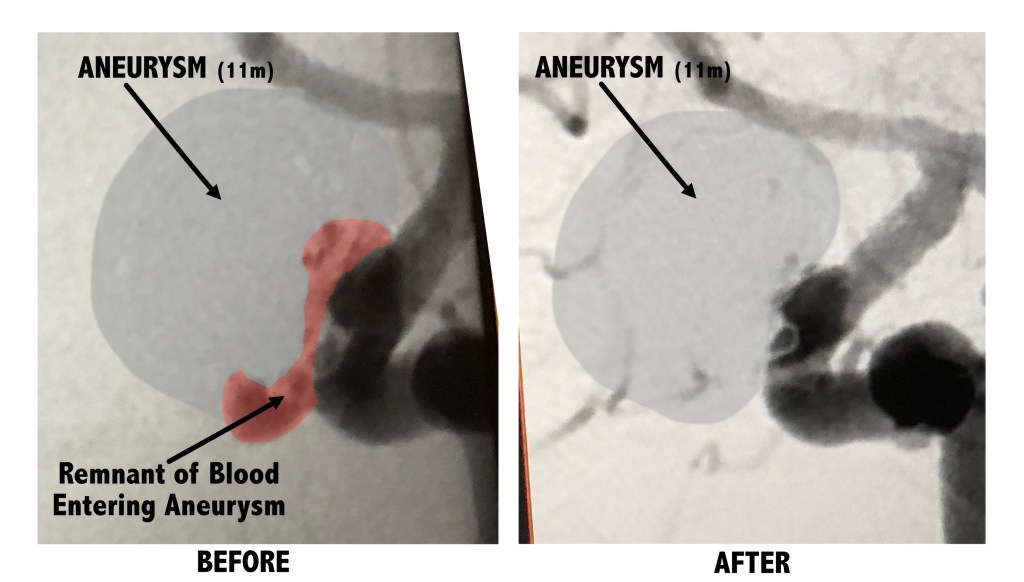
Seeing the images yesterday was remarkable! The areas where blood was previously getting into the neck of the aneurysm had almost disappeared and the artery where the flow-diverting stent was placed inside the older stent had conformed to the shape of the artery. This is EXACTLY what the hope was. Success!

Because this particular procedure, placing a stent inside another stent, is not a common practice, Dr. Ecker felt a follow-up MRA in three years would be best and I agree. Although we’re all thrilled to see how it’s taking shape after 7 months, giving it sufficient time for healing was recommended. THEN if it continues to look good, we’ll look at it every five years.

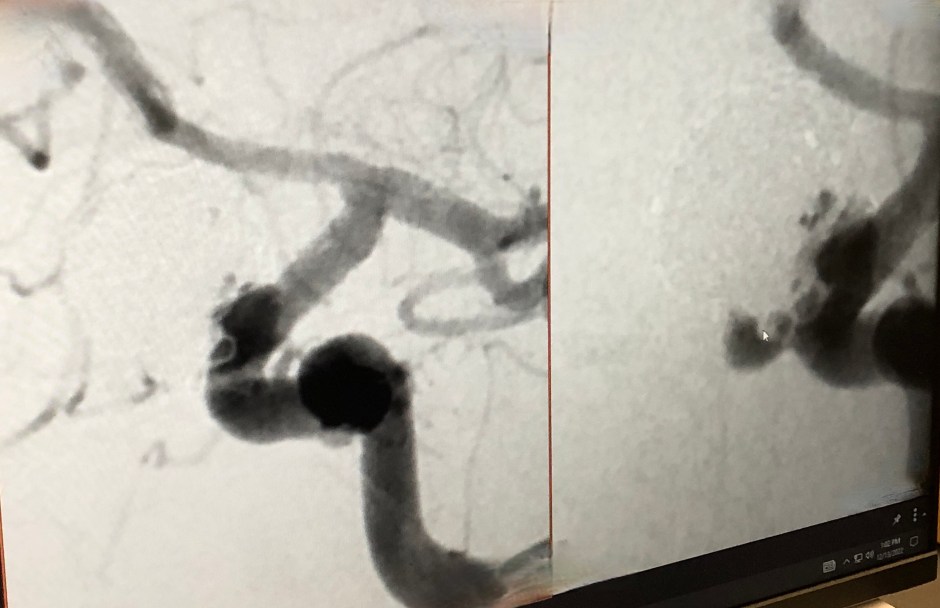
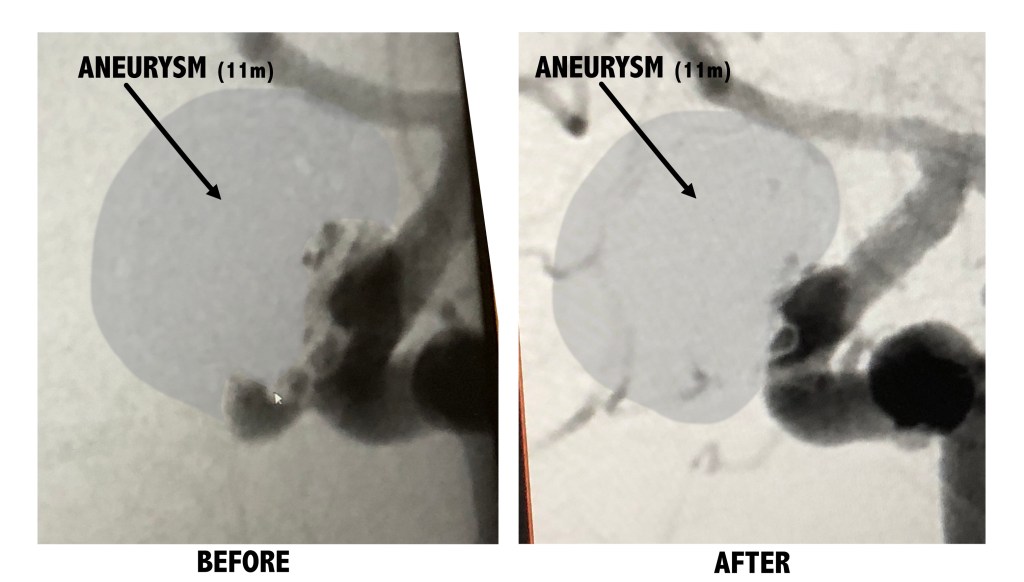
Below are a few photos I took of my images on the doctor’s computer screen. They aren’t the best, but I tried to indicate where things are for my readers. The two images placed side-by-side were backwards on his screen showing the AFTER image first, then the BEFORE image after it, so I had to cut them apart, flip them and I tried to keep them around the same size for scale. Hopefully, you’ll get the idea. And yes, I DO know I should have added another “m” for the size of my aneurysm. Don’t @ me. It took me a long time to get these images right and I’m too tired and busy to change them. 🙂

Raw image comparing the aneurysm and artery prior to flow diverter deployment and after
Indicating the location and size (approx. 1/2” in diameter) of the aneurysm, which is currently filled with 20 coils (not visible).
LEFT: Showing the area of blood that has been developing over a period of years into an aneurysm already susceptible to rupture. RIGHT: Now showing a reduction in size of the bloody area and a clearly defined artery.
RIGHT: Showing the relative location of the flow diverter placed within the older stent in the artery.

The Next Chapter

Yesterday was my 12th cerebral angiogram in 16 years. That’s a lot of images, a lot of stress, many procedures, successes, and even failures. Brain aneurysms don’t care what else is going on your life…they show up whether it’s snowing or not.

It was snow that greeted Dave and I yesterday morning as we were up before the sun rose to hit the road to Portland, a 60 mile drive south. Thankfully, we drove out of the snow about a quarter of the way there as a driving rain greeted us at the door of Maine Medical Center.

When multiple members of the hospital staff remember you from previous visits over the years, that should never be a good thing, but it is what it is in my case. I supposed it’s a comfort to see familiar faces who know my story.

Down in radiology, I was prepped for the procedure, hooked up to an IV, and answered everyone’s questions. Dr. Ecker came in to greet me and indicated he was excited to see how the flow diverter he deployed back in April was doing. Well…yes, I was too! He even opened up the images from the procedure on the computer in the prep area to view them with me and Jack, the PA, who has assisted Dr. Ecker with several of my other angiograms. Again…they know me here.

The procedure itself went very well. No issues and no pain or major discomfort. I was a good girl and didn’t move this time as some lovely classical music accompanied the staff in the endovascular suite.

While still on the table and hooked up to everything, Dr. Ecker said that things looked great, then he said “What Eddie Kwan started 16 years ago, ends today!”. Dr. Eddie Kwan was the doctor who performed the original coiling on my ruptured brain aneurysm in 2006 with 16 coils.

What Eddie Kwan started 16 years ago, ends today!”

Dr. Robert Ecker

At first, hearing those words brought tremendous relief and joy, then I saw the last 16 years flash before my eyes in a rapid succession of images…the fear when it ruptured, the loss of my husbands niece, the loss of my sister…my second brain aneurysm, the clipping, the recoiling, the stents…all of it in a millisecond of memories and feelings indelibly etched into my heart, brain, and soul.

20 coils, 1 clip, 1 stent, and 1 flow diverter

After that wonderful declaration by the doctor, a few more images were taken to get a good look at everything else then the doctors left and went to speak with Dave in the waiting room. While the rest of the staff were busily performing their post-procedure routines and unhooking things and cleaning me up, the tears started to unexpectedly flow.

My arms were still hooked up to things and down at my side within the arm guards, so one of the nurses touchingly came and dabbed the tears away from my eyes and face with a tissue for me. They were very comforting, in what was quite a personal and emotional moment for me, and I’m very thankful.

Dave was very surprised and concerned to see tears in my eyes when he joined me in the post-op area about an hour and a half from last seeing me. I assured him they were tears of joy, but he also knew why it was emotional for me because he has been with me through it all.

I was glad to learn what I heard from Dr. Ecker in the radiology suite matched up with what he told Dave seeing how I was a little drugged at the time. The flow diverter (pipeline) did it’s job. It adhered nicely inside the old stent and had paused the flow of blood from getting back into the neck of the aneurysm. He said it was “Done” and I wouldn’t need to go back for five years and it would just be the less invasive MRA scan next time.

The images that were taken yesterday will need to be closely looked at again just to make sure there isn’t anything else we should be concerned about, but during the doctor’s first look on the table, things looked good and it was a great report. I’ll have another follow-up in his office in December.

I pray this is a start of a new chapter in my life where I don’t have to worry about this damn aneurysm anymore. The rest is up to me…live life better and take better care of myself. I am lucky to be here at all.

I am so grateful, thankful, and blessed for the improved medical advancements in treating brain aneurysms and the skilled hands of Dr. Ecker and his stellar care over the last 10+ years. He knows what I’ve been through.

Two Fun Side Notes: Stephanie, my nurse in the pre & post care area is a Buffalo Bills fan and shared photos of her dogs dressed in Bills attire. What are the odds that two Bills fan, in Patriots country, run into each other in the hospital? Then I ran into Sara, our former brain aneurysm support group facilitator on our way out of the hospital. It was great to see her face. Again…they know me here. 🙂