Photo Shoot & Angiogram Follow Up

This morning my super model brain aneurysm posed for another photo. If I have many more MRIs/MRAs, I’ll stick to the fridge.

The reason for today’s photo shoot was to get a good baseline MRA shot of my large aneurysm and hopefully I can just continue to have MRAs instead of the more invasive cerebral angiograms in the future until they’re needed.

Thankfully, the Dr’s office was able to schedule the MRA on the same day as my follow up appointment for my angiogram that I had earlier in the month. So we headed out early to get to Scarborough by 8:15 a.m.

And it figures, today of all days, I get an ocular migraine right at 8 and had trouble seeing out of my right eye walking into the facility and in the MRA suite. It cleared up actually during the MRA and I could see fine afterwards. Thankfully they don’t cause me pain, just visual disturbance for about 30 minutes and I typically just don’t feel great the rest of the day.

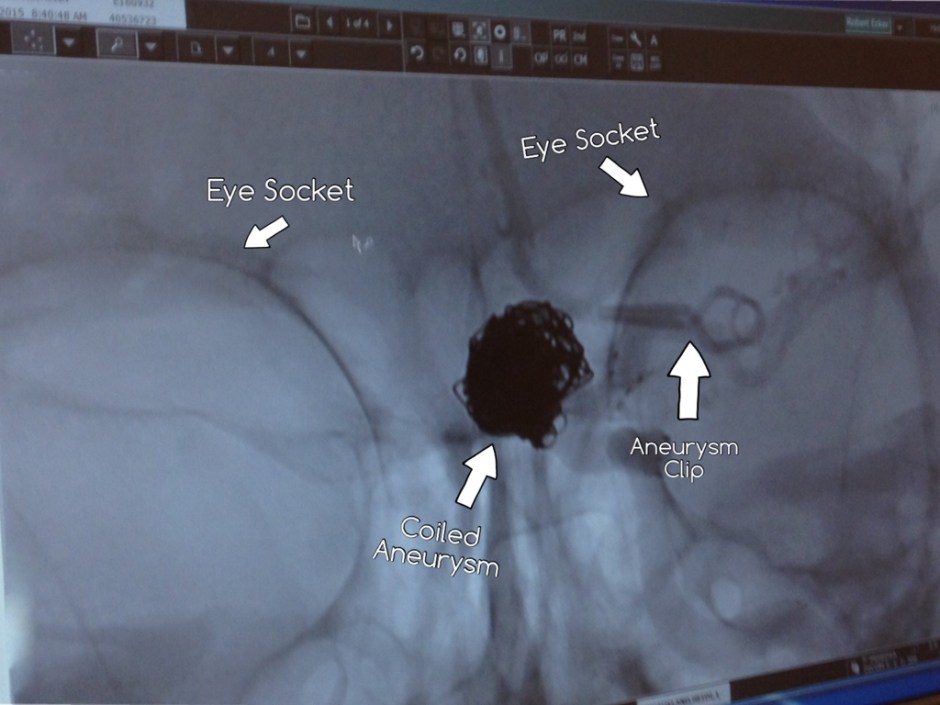
At the Dr’s office we looked at the images of the aneurysm from my angiogram as well as this morning’s MRA, which did show that remnant area where blood is getting back into the neck of the aneurysm. It appears to be below the coils and above the stent. We also looked at previous images and compared any changes to the size and shape for the little bugger.

Since the size and shape it basically the same since last year’s scans, the Dr. is recommending we wait and have an MRA again in two years and if it changes, we’ll add more coils. MORE coils. There are currently 20 pumped into it. Perhaps I really SHOULD call this aneurysm a super model….maybe it’s like continuing to get more Botox.

I’m not sure what results I was expecting from this appointment, but the watching and waiting to get more coils made me disappointed. I was hoping for something more permanent so I didn’t have to worry about this damn thing anymore. If 16 coils, then an additional 4 coils, then a stent weren’t able to stop the blood from getting into it, aren’t more coils also at risk of not working either?

I am struggling on trying to find the positive side of this determination. I DID agree to it but I’m the one who has to walk around with this unstable thing in my brain. I trust my doctor and I know if he felt it was an issue, he’d recommend the coiling NOW, but he doesn’t feel it’s a problem and currently, there are no other permanent procedures that would take care of my wonky arteries. Perhaps in two years something new will come out that CAN be placed inside a stent. Or the remnant will rupture…..see what I did there? I’m normally very positive, but this one is tough. It’ll come, just not tonight.

The good news was that the aneurysm that was clipped in 2014 looks “stunning”! LOL He is just so darned happy with himself for that picture-perfect clipping and I’m glad I was the lucky recipient of it. There! I found something positive.

This Year’s Angiogram

I’m seriously hoping this is my last angiogram for awhile. I’ve seen that angriography suite far too often the last several years. However, it’s the best way to see what’s really going on with my pesky vascular system.

As stated in my previous blog entry, this angiogram was to determine if there were any changes to my original 11mm brain aneurysm from last year when it was discovered more blood was starting to creep back into the neck of the aneurysm. Obviously, the 20 coils and the one stent weren’t doing the best job they could be, but I’m still here.

Since there was a chance I’d be staying overnight, I had to go to admissions first and check in, then we went straight to the radiology department. They were quite busy today, although I reminded myself I’m usually scheduled for much earlier appointments. This is the first time I’ve had an afternoon appointment and I was VERY hungry and thirsty after not having anything to eat or drink since midnight the night before.

Upon entering radiology, Dave and I were greeted from a distance by nurse John, who we usually see when we arrive there. It’s a mixed blessing when you’ve visited a place so often you become so familiar with the staff of a hospital. John told my attending nurse that I didn’t need any instruction because I knew exactly what I was supposed to do in here. LOL Yes…pretty true.

The IV was hooked up, more questions were asked, and more instruction was given. We were most curious about the balloon occlusion test and what that entailed.

The BOT is a little more risky and it would also require another port and catheter into my other arm where something would be injected to bring my blood pressure down during the test. I wasn’t looking forward to TWO catheters. Dr. Ecker explained the risks and why they’d keep me over night as more of a precaution. If I was doing great after the whole thing I could potentially go home and not have to stay.

I said my good-bye’s to Dave and was wheeled into the radiology angiography suite. As usual, the teams assembled for every single angiogram I’ve had at Maine Medical Center are top notch and always make me feel comfortable and at ease. Even though I’ve gone through many of these, it’s still a nervous time.

They allowed me to request a music station on their Pandora internet radio that was piped into the suite. I chose 80’s Throwback music. As the doctor walked in he said the music was a step up from the morning sessions. I said “You’re welcome”.

So enough of the pleasantries and on to the drugs, please! I’ve always had some pretty good pain when the catheter in my groin is inserted and I always request a little extra something special. Thankfully, they complied and it wasn’t too bad. They also inserted the IV into my left arm to prepare for a catheter for the balloon occlusion test. That was a little painful as well, but it didn’t last long.

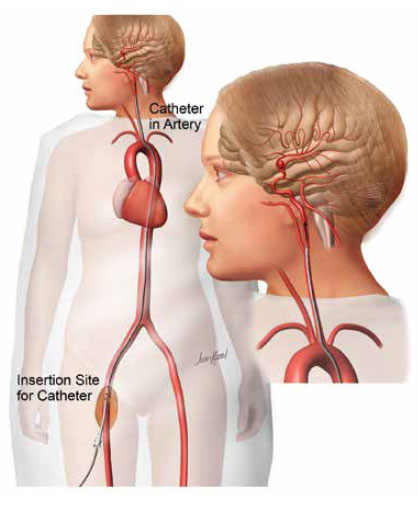
I know many people don’t understand why my groin hurts after having X-rays done on my brain. Aren’t they a tad far away from each other? Well, yes, but inserting a dye into that area gives a direct flight into the brain via one of the main cerebral arteries. I’m not sure why it’s going from the groin and not up higher on the body, such as the neck or chest, but it works, so I’m not going to question it.
image
During the angiogram, they take a series of images of the arteries then inject a dye to see exactly where the blood is flowing and take another series of X-rays. When the dye is injected I see a series of small horizontal lightning strikes behind my left eye. It’s brief, but weird. I keep my eyes closed during the whole thing, mainly because I’m dopey and can’t see anything without my glasses anyway, but because there is usually part of the machine directly above my head and there isn’t anything to see anyway.

After the initial angiogram, Dr. Ecker compared images taken last year at this time with the ones he just took. He was able to pull them up on the screen side-by-side, then even overlap them. He indicated there was absolutely NO change from last year, which was great news. Then he was questioning if we should even go ahead with the balloon occlusion test at that point since nothing had changed.

The main reason we were going to do the balloon occlusion test in the first place was to see if my vascular setup could even handle such a reversal of blood flow should a I NEED to have something dramatic done to prevent more blood from getting into the brain aneurysm.

Since there didn’t appear to be any immediate need for that, based on this angiogram, we both decided to forgo the BOT this time. I was okay with that. I wasn’t looking forward to more pain, or an overnight stay. However, a part of me was disappointed we just didn’t do it and get it over with now so we’ll know down the road.

Because they had expected to do a lot more, the large team assembled for this big event wasn’t really needed now and the last thing remaining in the radiology suite was the dreaded “plug”, or Angio-Seal™. The angio-seal is a small device that basically closes up the puncture site in the groin. However, since he used a larger catheter for today’s procedure, that larger plug was needed. It can be quite painful, mainly because I’ve been “poked so many times” as he said. Lucky me!

Why, yes…it WAS painful and they had to tell me to calm down, relax, and keep my leg down. I did. Still hurt. LOL The UPSIDE of using the closure device is that I only have to lay flat in recovery for two hours, not four or more hours if they were simply to apply preasure to the site for 15 minutes. The angio-seal allows the bleeding to stop much more rapidly and a quicker discharge from the hospital So, that’s the trade off for the pain.

image
The seal is comprised of three absorbable components: a small anchor, collagen, and a suture. The doctor guides the anchor through the hole created during the procedure where it is drawn in against the wall of the artery and the suture and collegian compact to create a secure seal over the entry point in the groin. All three components dissolve and are absorbed into my body in about 90 days. I’ll have an odd bump there for awhile, but the pain should ease after a few days.

The recovery in the radiology department is always long, but it seemed more so this time because they kind of forgot to offer me any food or water. It wasn’t until Dave asked them about an hour into my stay that I got a sandwich and some water. That’s highly unlike that crew and I was a little surprised.

Once they had me up on my feet for a short walking test and determined I wasn’t dizzy or unstable, I was discharged and walked out on my own. The only stop on the way home was at McDonalds for a shamrock shake! ‘Tis the season and it tasted sooooo good.

I developed quite a nasty headache on the ride home and was very glad we didn’t live any further than the 60 miles away we already did. The second I got in the door I had a cold cloth ready, heated my beanbag neck wrap, and crawled into bed for a good 7 hours. All the while keeping a pillow over my groin area so the cats wouldn’t jump directly on it. They did very good….been there, done that and I think they knew mommy wasn’t feeling well and cuddled with me all night.

My sleeping and eating pattern is all out of whack now and my groin is still giving me some pain. I’m pretty tired and not real stable. My head is going back and forth on whether it wants to bother me or not, but nothing I can’t handle. I’ve been in worse pain, been in worse condition, and I’m just lucky to be here.

However, there still is that lingering “issue”. Blood has gotten back into my original brain aneurysm and it’s still sitting there. Dr. Ecker wants me to get an MRA so we have a really good baseline image as it stands right now, then we’re hoping to just have MRA’s next time and not have to go through an angiogram as frequently. I’m all for that. Not that I enjoy MRA’s, but it’s far less invasive than angiograms, just loud and annoying. Then if they notice a change on an MRA, another angiogram will be ordered for a closer look.

I came away from this angiogram with mixed feelings. Yes, it’s great news that things hadn’t changed from last year, BUT there is still blood sitting there in the neck of a brain aneurysm that has already ruptured and we haven’t really resolved what to do with that. It’s almost a deja vu of last year. Something I guess I’ll still worry about until we see otherwise one way or the other. I don’t feel like I’m out of the woods yet from that pesky 11mm brain aneurysm. I should give it a name…any suggestions? (Keep it clean!)

 

The Good, The Bad, and The Tired

Tonight was my first time back to our brain aneurysm support group meeting since probably last September, possibly August. During catalog season I’m always working late and far too tired to go anywhere during the week. Ironically, fatigue and memory is a common theme at many of our meetings as it was tonight.

As always, it was good to see returning faces and I missed a few who weren’t there. We’re getting a nice “core” of survivors, care-givers, and those who have lost loved ones. The support is always there and we all try to listen to each other’s stories and offer validation for feelings and emotions that only those who have gone through the same thing can appreciate.

Unfortunately, I’ve had the brain aneurysm double-whammy; I myself, have suffered a ruptured brain aneurysm, and I have lost two loved ones to ruptures. I’ve seen both sides of the caregiving aspect, or those left behind, and I’ve also been a part of the survival and recovery part. Each part has struggles and pain.

Tonight, a father shared the story of the night his adult son’s brain aneurysm ruptured. It was a violent rupture and if he had been home alone, he would not have survived. His wife was able to revive him briefly – twice. He survived surgeries and a little bit of rehab and multiple rounds of different medications. He was at our meeting tonight while his father described the night it all happened to us. Even though his short-term memory has basically been lost, he cannot work or drive, and his family continues to endure a level of frustration and pain I cannot even begin to understand for several years now. But he IS alive, walking, talking, and able to function in some capacity.

Hearing a caregiver, and a father, talk about what happened that night, was difficult for me. My sister and Dave’s niece went through very similar experiences….or we can assume. My mind immediately raced to Dori’s rupture and how she lost consciousness on Mother’s Day and her husband was able to revive her while their 15-year old son called 911. But by that point it was too late. The damage from the rupture had already been done.

Then I thought about Kim, who was home alone when her rupture occurred. I can only hope and pray it was quick, but I also always wonder if someone had been there and found her sooner, if she’d be here today and if she were, what kind of life would she be living. The severity of her rupture and the location of it, leads me to believe Kim would not be the same person if she had survived. The same can be said for Dori.

We witnessed tonight the amazement in seeing a survivor of such a devastating rupture, but also the heart-wrenching pain in knowing their loved one will never be the same. That they can no long take care of themselves or their children. That they need major supervision. That they need to be reminded of things on an hourly basis to get through the day…yes, they DID survive, but in a sad way, they’re only a shell of the person they once were.

Is it only by the grace of God, that I am here today? Why did I survive and they did not? Why did I survive with very few deficits when others have continued issues and pain, even years after their ruptures?

I don’t like it when I come away from one of our meetings with these kind of questions. I should just be grateful and keep my mouth shut and never complain about anything, ever again. I AM one of the lucky ones…or one of the chosen ones…or just a person who was in the right place at the right time, with the right set of doctors. Fate? I don’t know.

I suppose those are all questions that will have to remain unanswered. Kind of like “Why doesn’t Fred Flinstone have horribly bloody feet when he has to stop his rock car with his heels?” Why? Why?

A Compelling Story

You need to have a compelling story. That’s what we’ve been told our group (Maine Brain Aneurysm Awareness) needs in order to get some local television coverage. Webster’s dictionary’s definition of the word “compelling” is:

: very interesting
: able to capture and hold your attention
: capable of causing someone to believe or agree
: strong and forceful
: causing you to feel that you must do something

So, apparently no one feels the following examples are compelling enough to warrant at least one television or newspaper interview in the last 6 years?

  • A vivacious 32-year old died suddenly in her bathroom of a massive ruptured brain aneurysm three days after Christmas. She lived alone and was found the following morning by her devastated mother. (The KAT-Walk was created in her memory & honor)
  • The husband of a ruptured brain aneurysm survivor also lost his niece and sister-in-law to ruptured brain aneurysms.
  • A woman from New Hampshire was vacationing in Maine and suffered a ruptured brain aneurysm in Shaw’s Supermarket. After a misdiagnosis, she eventually went to Maine Medical Center where the only interventional radiologist in the state saved her life. A few years later, she also survived breast cancer and a double mastectomy.
  • A man suffered a ruptured brain aneurysm while home alone. After many hours, his young children discovered him after coming home from school. Two hospitals and a trip to Boston saved his life.
  • A 40-year ruptured brain aneurysm survivor had to be taken to Canada.  At the time of her rupture, no one in the northeast did brain surgery for aneurysms then. The original clipping failed and she was re-clipped. Which means multiple craniotomies. She is a walking miracle.
  • A much-loved 53-year old woman died of a massive ruptured brain aneurysm on Mother’s Day after presenting symptoms two previous visits to doctors, leaving a husband and a 15-year old son behind.
  • A beautiful 28-year young woman, who was an active runner and very physically fit, suffered a ruptured brain aneurysm while working out. She never recovered leaving her family devastated. She was to be married only a few short weeks after her death. (The Karo-5K was created in her memory & honor)
  • One woman survived a ruptured brain aneurysm that was filled with 11 coils, only to lose her sister to a ruptured brain aneurysm six years later. Then Dr’s discovered she also had a second brain aneurysm which was clipped via a craniotomy, but the original one that ruptured is still giving her cause for concern 9 years later.
  • A father of three survived a devastating ruptured brain aneurysm. The deficits he and his family have faced are life-altering and difficult but he IS alive and living life to the fullest.
  • A woman’s ruptured brain aneurysm at 4 a.m. left her with limbs numb, speech slurred, a rapid heart rate, sweating, and falling to her knees. The EMT’s who arrived at her home took her blood pressure and asked some questions. They determined it wasn’t a serious issue and left it to the patient if she wanted to go to the hospital or not. Thankfully she went on her own and the Dr. in the ER sensed what it could be and had her scanned and transported to Maine Med where her life was saved.
  • A young, talented, 13-year old boy fell victim to a ruptured brain aneurysm in his home. The outpouring of grief and support after his death was overwhelming. (Nolan’s H.E.R.O. Foundation)

I could go on and on if I knew I could accurately describe the situations of everyone that I have met. So many stories of hope, fear, disaster, strength, and courage.

So…apparently none of those stories are compelling? How many people have to die and suffer debilitating deficits before this cause it compelling enough to the local news media? To those whose lives have been touched by brain aneurysms there is plenty to hold one’s attention. Survivors HAVE to begin to believe they’ll be fine or they’ll crumble. And in many cases of those left behind, the desire to DO something is overwhelming after these silent killers attack without warning in some cases. Our fundraising events do more than raise money to help other families, they raise the hope and spirits of those left behind or those surviving.

We were lucky enough to have a lovely article written about Kim after her passing. It was written in the local sports section because she was a fantastic softball player, but beyond that, we have received little to no local media support focused solely on our cause. It’s not for our group’s benefit…it is to raise awareness and to allow others who have been touched by brain aneurysms to gather and support one another.

Our cause doesn’t have a specific color that we brand; doesn’t have a celebrity spokesperson that everyone adores; or a social media “challenge”. The more we’re able to talk about brain aneurysms, the more awareness will be raised and hopefully we can SAVE A LIFE.

I think that’s pretty “compelling” don’t you?

READ MORE About Us: MaineBA.org

It is estimated that up to 1 in 50 people in the U.S. will develop a brain aneurysm during their lifetime. Each year about 30,000 people will suffer a ruptured brain aneurysm. Almost half of the victims will die and of those surviving, only one third will recover without disabilities.