Happy Puzzle Day!

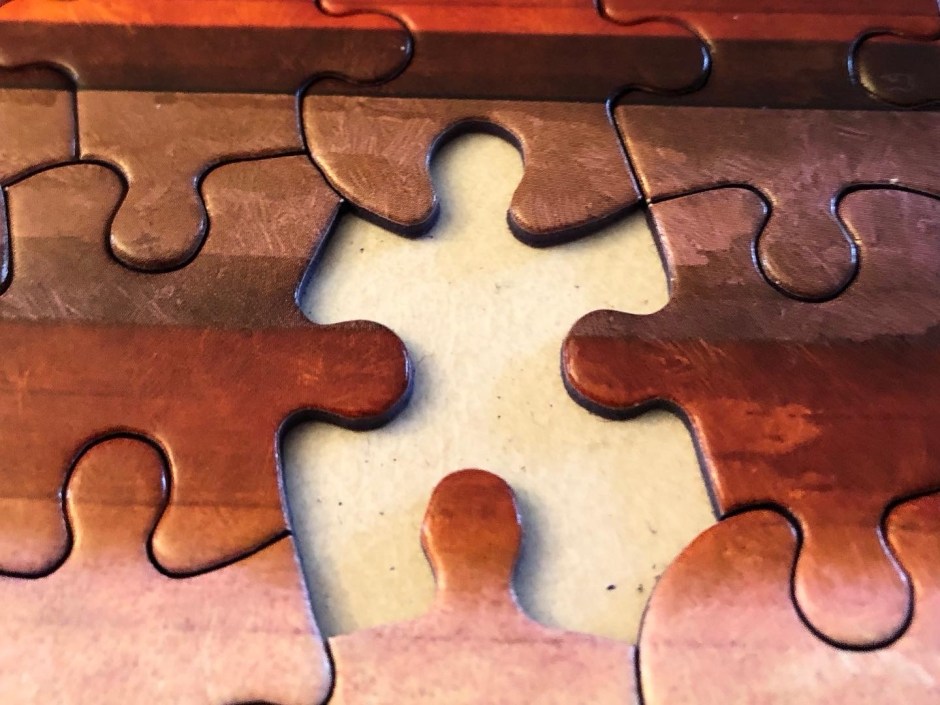
Happy National Puzzle Day! I can’t recall doing many jigsaw puzzles growing up. My first recollection of puzzles filling a need, was during the time my dad was fighting cancer. 

The hospital in Buffalo, NY where he was treated for five months, had a large waiting room where my mother and two sisters would gather until the next time we could see him. There was always a puzzle set out on the table. I found it a wonderful way to pass time, settle my mind on something other than the trauma our family was going through, and a small reward each time you found the right piece for the right spot. 

I picked up puzzles again, a few years ago after having a difficult couple of months where we had to say goodbye to our two beloved senior kitties within months of each other. I reconnected to the calming and challenging influence finishing a puzzle had.

As a brain aneurysm survivor, I also take comfort in knowing my brain is being exercised while working on puzzles.

According to many reputable online sources, working on jigsaw puzzles can help keep your brain healthy by improving memory, problem-solving skills, and cognitive function. Engaging in puzzles activates different parts of the brain, which can enhance overall mental sharpness.

Cognitive Improvement

  • Memory Enhancement: Jigsaw puzzles help improve short-term memory by reinforcing connections between brain cells.
  • Visual and Spatial Reasoning: They enhance the ability to visualize and manipulate objects in your mind, which is useful for tasks like reading maps or driving.
  • Problem-Solving Skills: Regularly solving puzzles encourages creative and effective problem-solving through trial and error.

Mental Health Benefits

  • Stress Relief: Engaging in puzzles can reduce stress levels, similar to meditation, by allowing the brain to focus on a single task.
  • Mood Enhancement: Completing puzzles increases dopamine production, which improves mood and concentration.

Overall Brain Health

  • Cognitive Delay: Regular participation in puzzles may delay the onset of dementia symptoms by up to two and a half years, although they cannot prevent dementia on their own.

Not all puzzles are alike, however. Some have thinner pieces, some have pieces that are the exact same size and shape, and others are frameless. I prefer ones with a straight edge frame, slightly larger pieces that aren’t too thin and that are cut in different shapes. I was gifted a hand-made puzzle and could not finish it. Not only was it printed on a glossy surface, which made seeing the pieces difficult, but they were all the exact same size and shape and very thin, which made it easy to misplace or slip out of my fingers. I ended up abandoning it because, although it was a huge challenge, it wasn’t fun or relaxing in ANY way.

My favorite puzzles are from White Mountain Puzzles in Vermont. I like to do 1,000-piece puzzles that are beautiful scenes or subjects that interest me like the ocean, cats, birds, or tea. The large, portable puzzle table I purchased also provides a safe place to house the puzzle and its pieces from our new kitties we adopted.

There is a true sense of accomplishment when I finally place that final piece.
Abusing the Gift

I’m always seeing survivors, not just brain aneurysm survivors, say they’re grateful for every day they’ve been given, or they wake up each day and feel that gratitude, and live their lives differently as a result of surviving. I have mentioned this before, but I guess I’m not one of those.

That’s not to say I am NOT grateful, blessed, lucky, and fortunate to be alive when others aren’t so lucky, but I feel I have not honored that gift that I’ve been given properly. In fact, I can honestly say I have abused that gift.

Have I taken better care of myself since my last report with the neurosurgeon? Nope. I still eat crap, still don’t exercise enough, and still drink wine – somedays a LOT of it. Instead of waking up and telling myself I’m going to run a 5k, I chose not to do much of anything to promote my survival. Which is a HUGE disservice to so many people who have helped me get to this point in my life: my family, my husband, my friends, and more importantly the doctors who have saved my life on a few occasions since 2006.

Many survivors make major changes in their lives: eat better, exercise more, get new less-stressful jobs, dedicate their lives to helping others…or run a 5k or marathon. I admire them, but that is not something I have done. Yes, I am part of our local brain aneurysm group and I help when I can and where I can, but I could certainly be doing more. And should be doing more.

I recently retired and now that I don’t have the daily stresses of the job, I’m feeling more retrospective than usual. I am also feeling guilty for not honoring the gift I’ve been given. SAYING I’m going to do better and DOING it are two very different things. Yes, it’s easier to eat better on a sunny day when your mood is lifted, but on those dark and stormy days in January, one feels more inclined to seek comfort in food, drink, and laying around. Yep…that’s my M.O.

For those who DO run 5ks and marathons, good for you. You keep doing you. I will never run a 5k, nor do I ever want to. I only run if someone is chasing me. But why does running a 5k seem to be the most important thing for survivors to do? And why do 5ks seem to represent the one way survivors honor their survival? Doesn’t every survivor, who just wakes up the next day and LIVE, a 5k-type of event? Nope…they don’t get that kind of recognition. For those who have trouble moving during the day and have additional physical ailments, just getting out of bed in the morning is a huge accomplishment and should be celebrated just like getting interviewed for the local TV for finishing a 5k and for getting an article in a magazine because you ran a 5k…and of course it also helps if you’re an attractive blond and is thin and already fit not a chubby 60-year old, right?

This past week I learned that a fellow brain aneurysm survivor, Helen, passed away at the age of 71. I’m so very sad about this. She was a loving, kind, and strong woman who had endured many struggles like the loss of a young child well before she had to survive a brain aneurysm. THAT deserves praise. THAT deserves notice. She and her husband, who is blind, have had a rough time, but have maintained positivity and warmth whenever we’ve met with them. Helen had many physical limitations later in her life that effected every aspect of their lives. I will always remember her fantastic smiles, warm hugs, and terrific cooking.

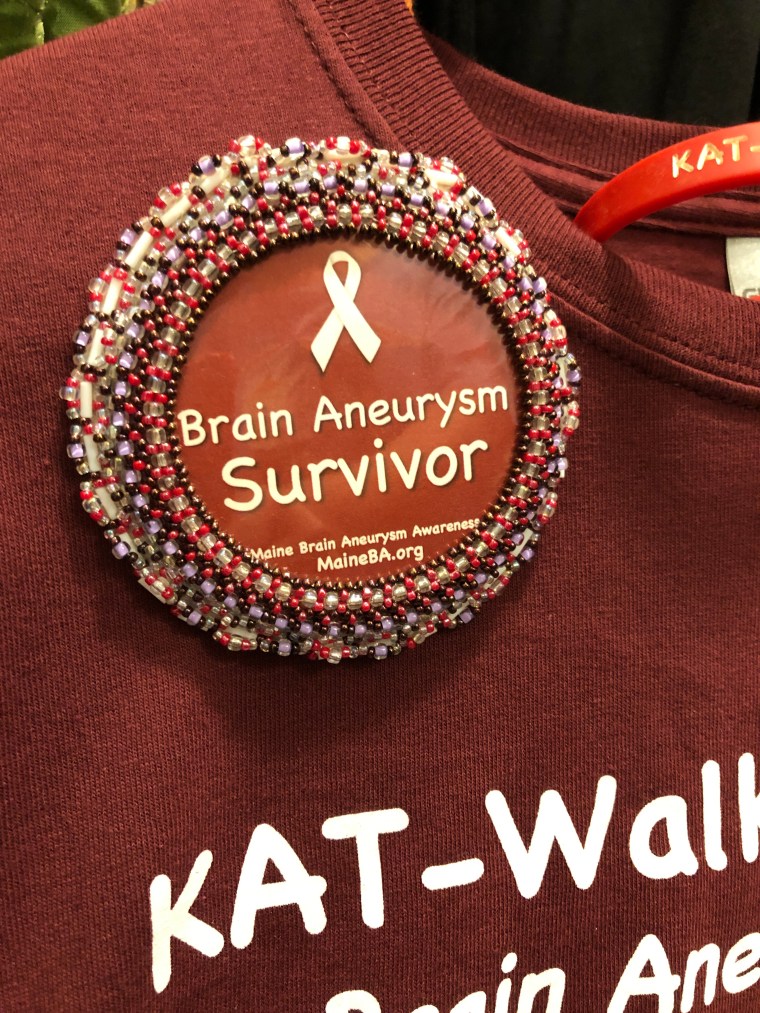
Helen wanted to give back to the brain aneurysm community and she asked Dave and I if she could add beading to our brain aneurysm survivor pins. We had no idea just how beautiful these would be, nor the amount of work she’d put into them. The Native American beading was a talent of Helen’s and it gave her a “job” to do and eased her back into creating this beautiful artwork. I proudly keep her pin on my purse and it always produces positive comments and I always give Helen credit. I will treasure this small gift even more now.

The beautifully-beaded survivor pin that Helen gave me.

Knowing Helen was a gift. My being on this planet is a gift. I need to stop abusing these gifts and step up to honor them. I AM fortunate and blessed. I just need to act like it…just not with a 5k in case I haven’t mentioned that before. 🙂