
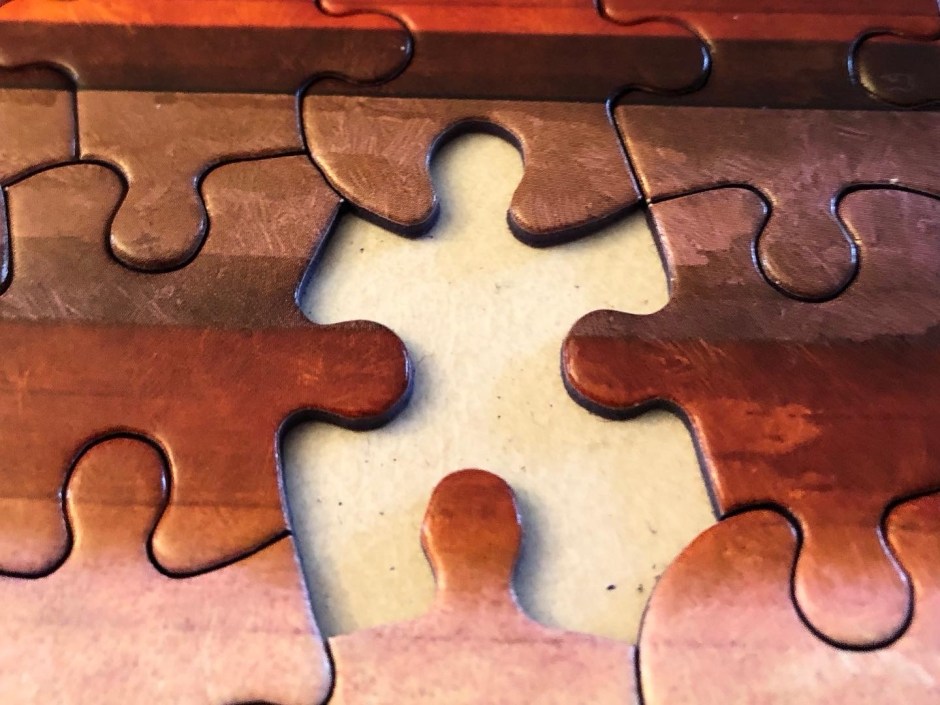
Happy National Puzzle Day! I can’t recall doing many jigsaw puzzles growing up. My first recollection of puzzles filling a need, was during the time my dad was fighting cancer.
The hospital in Buffalo, NY where he was treated for five months, had a large waiting room where my mother and two sisters would gather until the next time we could see him. There was always a puzzle set out on the table. I found it a wonderful way to pass time, settle my mind on something other than the trauma our family was going through, and a small reward each time you found the right piece for the right spot.
I picked up puzzles again, a few years ago after having a difficult couple of months where we had to say goodbye to our two beloved senior kitties within months of each other. I reconnected to the calming and challenging influence finishing a puzzle had.
As a brain aneurysm survivor, I also take comfort in knowing my brain is being exercised while working on puzzles.
According to many reputable online sources, working on jigsaw puzzles can help keep your brain healthy by improving memory, problem-solving skills, and cognitive function. Engaging in puzzles activates different parts of the brain, which can enhance overall mental sharpness.
Cognitive Improvement
- Memory Enhancement: Jigsaw puzzles help improve short-term memory by reinforcing connections between brain cells.
- Visual and Spatial Reasoning: They enhance the ability to visualize and manipulate objects in your mind, which is useful for tasks like reading maps or driving.
- Problem-Solving Skills: Regularly solving puzzles encourages creative and effective problem-solving through trial and error.
Mental Health Benefits
- Stress Relief: Engaging in puzzles can reduce stress levels, similar to meditation, by allowing the brain to focus on a single task.
- Mood Enhancement: Completing puzzles increases dopamine production, which improves mood and concentration.
Overall Brain Health
- Cognitive Delay: Regular participation in puzzles may delay the onset of dementia symptoms by up to two and a half years, although they cannot prevent dementia on their own.
Not all puzzles are alike, however. Some have thinner pieces, some have pieces that are the exact same size and shape, and others are frameless. I prefer ones with a straight edge frame, slightly larger pieces that aren’t too thin and that are cut in different shapes. I was gifted a hand-made puzzle and could not finish it. Not only was it printed on a glossy surface, which made seeing the pieces difficult, but they were all the exact same size and shape and very thin, which made it easy to misplace or slip out of my fingers. I ended up abandoning it because, although it was a huge challenge, it wasn’t fun or relaxing in ANY way.
My favorite puzzles are from White Mountain Puzzles in Vermont. I like to do 1,000-piece puzzles that are beautiful scenes or subjects that interest me like the ocean, cats, birds, or tea. The large, portable puzzle table I purchased also provides a safe place to house the puzzle and its pieces from our new kitties we adopted.
There is a true sense of accomplishment when I finally place that final piece.

 Heidi's Brain Blog